While we enter in this year 2026, online transaction security and payment processing in e-commerce has become crucial. With digital commerce continuously growing, customers expect secure online payments, fast checkout experiences, and zero tolerance for data breaches or fraud.
Even a single concern in payment security can damage customer trust, increase chances of cart abandonment, and expose businesses to financial and legal risk.
Due to this, modern e-commerce platforms have to invest in advanced online transaction security while also maintaining smooth payment processing across devices and regions.
In 2026, e-commerce payment security has to be beyond protecting credit card numbers. Businesses have to actively defend against account takeover(ATO), bot-driven fraud, card testing attacks, friendly fraud, and increasing chargebacks.
Shoppers have to expect different payment methods like digital wallets, Buy Now Pay Later(BNPL) options, subscription payments, and cross-border transactions.
For handling different payment options safely merchants require strong PCI DSS compliance, payment tokenization, end-to-end encryption, and real-time fraud detection which works across every channel and device smoothly.
New and evolving regulations are shaping how payment processing in e-commerce verifies customers, protects data, and handles transactions.
With requirements like Strong Customer Authentication(SCA), 3D Secure(3DS), and stricter data privacy laws, merchants are shifting toward intelligent, risk-based verification that strengthens security while keeping the checkout smooth and fast.
In 2026, risk-based authentication will be used more widely which will keep legitimate, low-risk purchases smooth and fast while automatically adding extra checks only when a transaction looks suspicious.
In 2026, more merchants will depend on risk-based authentication to keep low-risk purchases smooth and fast while automatically adding extra checks only when a transaction indicates potential fraud.
Artificial Intelligence(AI) and machine learning will become core tools in 2026 payments, helping merchants identify fraud in real time while keeping approval rates high.
This guide explores what to expect from online transaction security and e-commerce payment processing in 2026, helping merchants reduce fraud, improve checkout performance, protect customer data and build long-term trust in an increasingly complex digital payments ecosystem.
Also Read: How to Choose the Right POS System for Your Business
What to Expect from Ecommerce Payment Processing in 2026
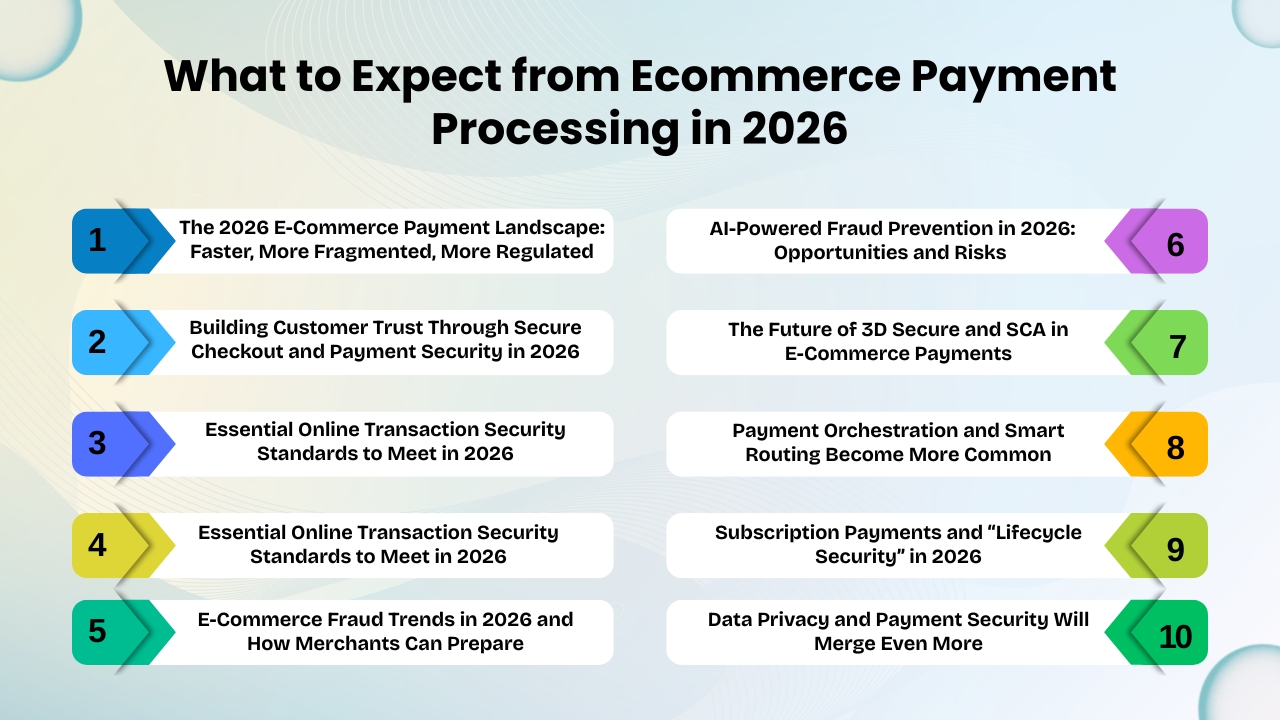
1. The 2026 E-Commerce Payment Landscape: Faster, More Fragmented, More Regulated
If you operate an online store, you might have already known that payment options are increasing and customers now expect every checkout to be faster, easier, and more secure than ever.
In 2026, the winning checkout will be the one that provides speed, convenience, and trust as it determines whether a transaction fails or succeeds.Shoppers no longer compare your checkout not just to competitors in your niche while they compare it to the fastest, smoothest digital experience they use every day.
Customers now expect “instant” everything. That includes instant approvals with no confusing redirects, instant confirmation through email, SMS, and real-time order tracking, and instant access for digital goods, subscriptions, and online services.
Even after the purchase, customers still expect speedy support with quick dispute handling, clear refund timelines, and transparent returns. Any delay or uncertainty can lead to cart abandonment or chargebacks.
This demand for speed creates a major challenge for merchants. Merchants must keep checkout smooth and fast while still enforcing strong online transaction security at every step.
If you simplify checkout, it can increase fraud risk, while adding too many security checks can frustrate legitimate customers. It is essential to find that balance which is one of the challenges of payment processing in 2026.
At the same time, payment choices are also widening. Though credit and debit cards remain dominant, top e-commerce brands increasingly offer digital wallets like Apple Pay, Google Pay, and PayPal, along with Buy Now Pay Later(BNPL)options.
Bank payments and instant account-to-account transfers are growing in several markets, local payment methods are becoming crucial for cross-border growth, and subscription billing is rising—creating ongoing payment relationships that must be managed securely.
More payment options can increase conversions, but they also increase your risk exposure so every payment method you offer needs consistent security controls, fraud detection, and monitoring.
In 2026, business should expect stricter enforcement around Strong Customer Authentication(SCA), stricter data protection and privacy rules, clearer consumer protection requirements for refunds and BNPL disclosures, and increased scrutiny related to anti-money laundering(AML) and KYC especially for marketplaces and high-risk models.
As a result, security decisions are no longer driven by fraud prevention, but also by legal exposure and brand reputation, making payment strategy a board-level concern rather than just a technical concern.
Also Read: The Future of Retail Payments
2. Building Customer Trust Through Secure Checkout and Payment Security in 2026
For a long time, many e-commerce businesses treated security as something that customers would never have to think about. Fraud checks ran quietly in the background, payment tokenization protected card data behind the scenes, and monitoring systems worked out of sight.
While these protections were essential, they were largely invisible to shoppers. In 2026, that approach is no longer enough because the most successful brands will adopt “trust by design” making security visible, reassuring, and smoothly integrating into the buying experience without any concerns.
Today’s customers are highly aware of online risks. They recognize warning signs instantly like unfamiliar redirects, poorly designed checkout pages, or unclear payment confirmations.
Even the most secure payment flow can lose sales if it is not secure. While trust by design will matter more than ever by using clear messaging, consistent branding, and transparent payment details that reassures customers.
In practice, trust by design begins with a clean, intuitive checkout interface. In 2026,customers should instantly recognize your business at checkout and receive a clear, simple explanation whenever they receive an extra verification step.
Using recognizable and secure payment methods, like digital wallets or verified processors, instantly indicates legitimacy. Clear billing descriptors, branded receipts, and accurate order confirmations help prevent confusion that can later turn into disputes or chargebacks.
When extra verification is needed, it should be fast, clearly explained, and consistent so it feels like a protective step for the customer and not an unexpected challenge.
Clear explanations about why a verification step lowers frustration and improves checkout completion, while upfront refund, return, and shipping policies build confidence by setting expectations after payment.
Ultimately, a consistent brand experience across payment pages especially with hosted or third-party checkouts reduces doubts, and when the experience feels consistent end to end, customers are far more comfortable completing the purchase.
In 2026, trust directly impacts revenue and when checkout feels secure and transparent, conversions rise, disputes reduce, and customer loyalty grows.
Also Read: Smart POS System the Secret of Faster Checkouts
3. Essential Online Transaction Security Standards to Meet in 2026
As online shopping grows and threats evolve, key security measures are shifting from “optional best practice” to the standard every e-commerce store is expected to meet.
By 2026, these security standards will be the foundation for safe e-commerce, and merchants who don’t adopt these standards are more likely to experience higher fraud rates, more chargebacks, more declined payments, and growing compliance risks.
In 2026, more payment flows will use tokenization, swapping real card details for single use or network tokens that keep sensitive data out of your systems and reduce data breaches.
Network tokenization will grow rapidly to improve approval rates and reduce fraud, while vaulted tokens will enable one-click checkout, stored cards, and secure subscription payments for faster repeat purchases.
Tokenization also supports account updater tools that automatically replace expired card details to reduce failed transactions and subscription churn making it a must-have for any business that stores payment methods.
In 2026, security will extend beyond basic HTTPS, requiring stronger encryption at rest, regular key rotation policies, least-privilege access controls, and detailed activity logging.
These security measures reduce both internal and external risk enabling quicker detection of suspicious behavior.
measures reduce both internal and external risk while supporting faster detection of suspicious behavior. By 2026, security audits will become regular while doing business, as partners and enterprise clients expect measurable and documented proof of your data protection standards.
A PCI DSS 4.0 mindset will shape compliance in 2026, as Payment Card Industry standards move toward flexible, risk-based security programs that still demand stronger accountability, monitoring, and evidence of control effectiveness.
Merchants should plan for risk-based PCI expectations, stronger evidence, and reporting, and closer oversight of third-party vendors. Even when a payment processor handles most PCI responsibilities, businesses must understand what remains within their own PCI scope.
In 2026, authentication will feel lighter for customers as biometrics, device verification, passkeys, and smarter identity indications become the default way to confirm legitimate buyers.
Risk-based authentication will challenge only suspicious transactions, allowing legitimate customers to move through checkout smoothly.The goal is simple to block fraud in the background while keeping the checkout experience smooth for genuine customers.
Also Read: Why Business Gets Rejected for Online Merchant Account
4. Essential Online Transaction Security Standards to Meet in 2026
A major 2026 shift in online transaction security is that identity verification is becoming central to whether a payment is approved. Rather than forcing a separate login or verification step, checkout will increasingly verify identity automatically as part of the payment flow.
This creates faster checkouts for real shoppers and stronger fraud prevention, replacing outdated steps with smarter, behind-the-scenes verification.
The most visible change is the shift away from passwords, which are often reused and easily compromised through phishing, malware, or data breaches.
In 2026, top e-commerce platforms will reduce username-password logins and adopt low-friction options like passkeys, using device-based authentication and biometrics to secure account access with less hassle.
Single-tap wallet payments using fingerprint or facial recognition will become the quickest trusted checkout option, while magic links via email/SMS will let customers sign in securely without passwords.
When risk increases like a new device, sudden location change, or unusually large order then step-up-authentication will appear only at moments of genuine risk.
In 2026, fraud tools will rely heavily on real-time identity signals, using behavioral and contextual data to score risk instantly as a customer moves through checkout.
These signals include device reputation(whether the device has a trusted history) and behavioral patterns like typing speed, navigation flow, and how quickly checkout forms are completed.
Location and IP intelligence help identify suspicious changes or high-risk regions, while account age and purchase history provide context that helps confirm a customer’s legitimacy.
Velocity checks identify rapid repeat activity that indicates card testing or automation, and because these signals work in the background, merchants rarely notice them and customers simply experience a smoother, effortless checkout.
With smarter risk scoring, false declines decrease, unnecessary challenges disappear, and approval rates rise without increasing fraud exposure.In 2026, checkout will feel almost instant because behind-the-scenes identity checks keep real buyers moving while stopping fraud before it can complete a transaction.
Also Read: Instant Approval For Online Merchant Account
5. E-Commerce Fraud Trends in 2026 and How Merchants Can Prepare
Fraud never stays the same, rather it adapts. By 2026, familiar attacks will become more automated and coordinated than ever, so staying aware of how these threats evolve helps you protect revenue while keeping the checkout experience smooth.
Understanding how these attacks evolve is crucial to reducing losses without disrupting legitimate customers.
Account takeover will remain a major risk in 2026 as fraudsters are no longer focused only on card numbers rather they target full customer accounts.
In 2026, account takeovers will be a major security threat, as criminals use stolen logins, session tokens, loyalty points, saved cards, and stored addresses to place expensive orders that appear completely legitimate.
To stay ahead, merchants should promote passkeys or stronger login authentication, track unusual login behavior or location changes, and cause step-up verification for actions like address updates or large purchases.
To prevent credential-stuffing attacks, combine strong bot detection with strict rate limiting on login endpoints to slow automated attempts and protect customer accounts.
In 2026, synthetic identity fraud will keep rising as criminals combine real and fake information to build believable profiles, test with small transactions, and then scale up to larger, higher-risk profiles.
Because synthetic fraud can look normal at first, merchants need long-term behavior tracking using tools that identify mismatches, watching account patterns over time, and applying tighter checks when new accounts place unusually large orders.
Automatically saving proof like delivery confirmations, customer messages, and policy acceptance records strengthens your chargeback evidence and improves dispute win rates.
Bot fraud will keep scaling in 2026 testing stolen cards, abusing coupons, hoarding inventory, and creating fake accounts so merchants need bot detection, smart rate limits, velocity controls, and coupon restrictions, adding friction only where abuse appears.
Also Read: High Risk Merchant Account Instant Approval
6. AI-Powered Fraud Prevention in 2026: Opportunities and Risks
In 2026, AI-driven fraud prevention tools will become standard across e-commerce and not just for large enterprises but also for mid-market merchants who previously lacked access to advanced systems.
Artificial intelligence is making fraud detection faster and more precise, allowing merchants to reach in real time to evolving risk signals instead of depending on outdated static state rules.
In 2026, machine learning will sharpen fraud detection by identifying subtle behavior patterns that human reviewers often miss allowing merchants to catch frauds earlier.
AI can continuously tune risk limits as fraud patterns change and quickly identify bot clusters and coordinated attack waves that are common in card testing and account takeover before they spread.
However, AI introduces a crucial challenge which is false declines. Declining a valid transaction not just lost sales, it creates frustration, damages brand trust, and can force shoppers to complete the purchase somewhere else.
In 2026, the strongest fraud strategies will be dynamic and data-connected combining checkout, customer, and risk insights to choose the right path(approve, step up, or review) while continuously adjusting controls as fraud patterns change.
At the same time, fraudsters are using AI to create more convincing scams and smarter bots, which makes single-layer security defenses ineffective.
To stay ahead in 2026, merchants need layered, adaptive security combining AI detection with human review, strong authentication, behavioral signals, and continuous tuning because it becomes a powerful advantage in the ongoing fight against fraud.
Also Read: Top Retail Payment Trends
7. The Future of 3D Secure and SCA in E-Commerce Payments
In markets where Strong Customer Authentication (SCA) applies, 3D Secure (3DS) will remain a core layer of protection for e-commerce payments.
By 2026, however the way 3DS is implemented will matter more than before because merchants who apply it intelligently will benefit from lower fraud and fewer chargebacks, while those who depend on right setups damage conversion rates.
The biggest improvement in 2026 will be the rise of frictionless 3DS flows for low-risk transactions. When risk indicates a legitimate customer, authentication can happen silently in the background without any additional input.
Improved exemptions and smarter step-up challenges will allow issuers and merchants to cause extra verification only for truly high-risk transactions, reducing unnecessary checkout interruptions.
Mobile experiences will also improve, with cleaner interfaces, faster authentication steps, and stronger integration with device-based verification and biometrics.
In 2026, 3DS success comes from risk-based configuration—not an on/off switch—so merchants should adapt challenges based on value, customer history, device and location signals, and track conversion impact by region and payment method.
When extra authentication is required, the checkout should clearly explain why it’s happening and what to do next because even legitimate security steps cause cart abandonment if customers feel confused.
When implemented properly, 3DS and SCA can reduce fraud, shift liability, and improve approval rates.
8. Payment Orchestration and Smart Routing Become More Common
By 2026, payment orchestration will become mainstream as growing e-commerce brands add more payment methods and markets, making single processor dependence too risky for uptime and acceptance.
Payment orchestration reduces downtime, improves approval rates, and keeps checkout running smoothly by rerouting transactions when a provider slows down or fails.
At its core, payment orchestration serves as a central control layer for transactions. With smart payment orchestration, merchants can automatically send each transaction to the best-performing processor or acquirer based on factors like location, card type, order value, and real-time approval rates.
With a single integration, businesses can offer cards, digital wallets, BNPL, and local payment methods without constantly reworking or rebuilding their checkout for every new provider.
In 2026, automatic fallback routing will help protect sales by smoothly shifting transactions to a backup processor when the primary option slows down or fails, preventing unnecessary failed checkouts.
Beyond reliability, payment orchestration improves security by centralizing transaction data, allowing merchants to enforce consistent fraud rules and risk scoring across every payment method, region, and processor.
A major benefit of orchestration in 2026 is consolidating processors and fraud tools into one layer, it simplifies operations, closes security gaps, and lowers the chance of costly misconfigurations across providers.
For high-volume merchants or businesses expanding globally, orchestration delivers resilience because during outages, attacks, or regional disruptions, transactions continue flowing.
Also Read: Top 5 Feature Every Retailer Should Look into Modern Payment Terminal
9. Subscription Payments and “Lifecycle Security” in 2026
Subscription models continue to be a powerful growth engine for e-commerce businesses but they have unique and ongoing payment risks.
Unlike one-time purchases, subscriptions require secure billing over weeks, months, or even years. In 2026, protecting subscriptions will mean focusing not just on checkout security but on lifecycle security protecting every payment event from signup, renewal, upgrade, and cancellation.
Several important changes are shaping subscription payments in 2026 like merchants will depend more heavily on network tokens and account updater tools to reduce failed renewals caused by expired or replaced cards.
These tools help maintain continuity in recurring billing while reducing involuntary churn. In 2026, improved retry and recovery tools will help merchants reattempt failed payments with smarter timing and logic, reducing churn without causing fraud alarms.
In 2026, regulators and consumers will force merchants to eliminate dark patterns and make renewals, pricing, and cancellations straightforward and clearly communicated.
A strong subscription security plan begins with transparency like clear opt-in confirmation, upfront renewal disclosures, and simple pricing details at the moment a customer signs up.
Easy cancellation is no longer just good customer experience, rather it’s an important defense against chargebacks and regulatory complaints.
While the businesses should maintain strong evidence logging, including timestamps, IP addresses, and confirmation of terms acceptance to support dispute resolution.
Smart retry logic matters in 2026 because overly aggressive retries can look like fraud and trigger network alerts, while weak retry strategies increase churn so monitoring refund and chargeback spikes helps catch billing issues or abuse early.
In 2026, the goal is not simply secure checkout rather it’s secure, transparent, and compliant subscription billing across the entire customer lifecycle.
10. Data Privacy and Payment Security Will Merge Even More
In 2026, privacy and payment security will merge even more, and customers will expect transactions that are protected end to end and have clear control over how their data is collected, stored, and shared.
The strongest checkout experiences will reduce risk in the background while keeping the buying journey fast and smooth.
Merchants should limit storing personal data wherever possible, depend on tokenization, and use secure processors rather than keeping sensitive details in-house.
Clear consent and data-usage notices will matter more than ever, especially when analytics, fraud tools, or marketing integrations access identity signals.
Customers need to know what’s collected, why, and how it’s protected. Strong vendor risk reviews and a documented incident response plan will also be critical. Even small leaks can damage trust and revenue.
Conclusion
As e-commerce heads into 2026, online transaction security and payment processing are no longer behind the scene concerns anymore; rather they directly shape customer trust, checkout conversion, and sustainable long-term growth.
In 2026, customers expect checkout to be quick and effortless, but they also want privacy, transparency, and secure data handling so merchants must provide smooth payments while applying smart, risk-based protection on every transaction.
By 2026, payment security will be powered by smarter systems using tokenization, risk-based authentication, AI fraud detection, and payment orchestration to reduce fraud and chargebacks without slowing down legitimate shoppers.
Due to increasing regulatory pressure, higher privacy expectations, and cross-border complexity will require merchants to build security into every stage of the customer journey from login and checkout to subscriptions, refunds, and chargeback disputes.
Merchants depending on strict rules, a single processor, or outdated authentication will face more false declines and lost sales, while those that combine adaptive security with a smooth, intuitive checkout will win customer trust and conversions.
Businesses that invest now in modern payment infrastructure, privacy-first design, and continuous optimization will earn lasting customer trust in an increasingly competitive digital commerce landscape.
If you still have any questions about online transaction security and payment processing in e-commerce in 2026 then you may write to us at Ace Merchant Processing and we are more than happy to assist you.