Merchant services are the foundation of modern commerce which allows businesses to accept and process payments effectively across multiple channels.
At their core, merchant services are a collection of financial solutions that allows businesses to accept credit card payments, debit card payments, mobile wallets, and online transactions.
Whether you are operating a retail store, restaurant, or eCommerce platform it is essential to have reliable payment processing such as Ace Merchant Processing which enables offering a smooth customer experience and driving revenue growth.
The process begins with a customer making a purchase using his card or digital payment method through a point of sale(POS) system or online checkout.
The payment data is transmitted securely through a payment gateway to the acquiring banks. It then connects with the card network and the customer’s issuing bank to verify and approve the payment transaction.
Then, within seconds, the transaction is either approved or declined which ensures fast and secure payment processing. Components of merchant services comprise payment gateways, processors, and merchant accounts which work together to complete transactions smoothly.
For businesses, merchant services go beyond just accepting payments. It includes features such as fraud protection, PCI compliance, recurring billing, invoice payments, and detailed sales reporting.
While advanced solutions also support contactless payments, EMV chip cards, and allows integrations with accounting or inventory systems that makes operations more efficient.
In this highly competitive market, it is essential to select the right merchant service provider that can significantly impact business performance. Also factors like transaction fees, processing speed, security, and scalability play an important role in decision-making.
Using modern merchant services helps businesses to enable smooth payment operations and also improve customer satisfaction, cash flow, and stay ahead.
Also Read: What is Payment Processing Software
What Are Merchant Services?
Merchant services include a collection of financial tools and solutions that helps businesses to accept and process customer payments. These services are offered by banks, payment processors, or specialized merchant service providers.
Core merchant services include:
- Payment processing for credit and debit card transactions
- Point-of-sale (POS) systems for in-store purchases
- Payment gateways for secure online transactions
- Mobile payment solutions for accepting payments anywhere
- Fraud detection and security tools to protect customer data
- Reporting and analytics to track sales and performance
In simple terms, merchant services help businesses to get paid electronically and manage those payments in an organized way.
It helps to improve speed, security, and customer experience and also supports everyday business operations. Merchant services are crucial for modern businesses for running efficient and reliable payment systems.
Also Read: Instant Approval Online Merchant Accounts
Why Merchant Services Are Essential for Businesses
The way customers make payments has significantly changed in recent years. Because cash is no longer the preferred payment option for shoppers as they have started using credit cards, debit cards, mobile wallets, and online payments for completing their everyday transactions.
Customers today expect businesses to provide fast, secure, and flexible payment options while they are shopping in-store, online, or mobile devices.
While businesses that do not adapt to these changing payment expectations may lose their customers to competitors who provide convenient payment options.
Merchant services are crucial because it gives the essential tools to your businesses that help to accept these payment methods efficiently. It helps to streamline transactions, improve operations, and support business growth.
Whether you are running local shops or large enterprises, merchant services have become essential for staying competitive in a digital market.
Also Read: How to Build Payment Franchise With Ace Merchant Processing
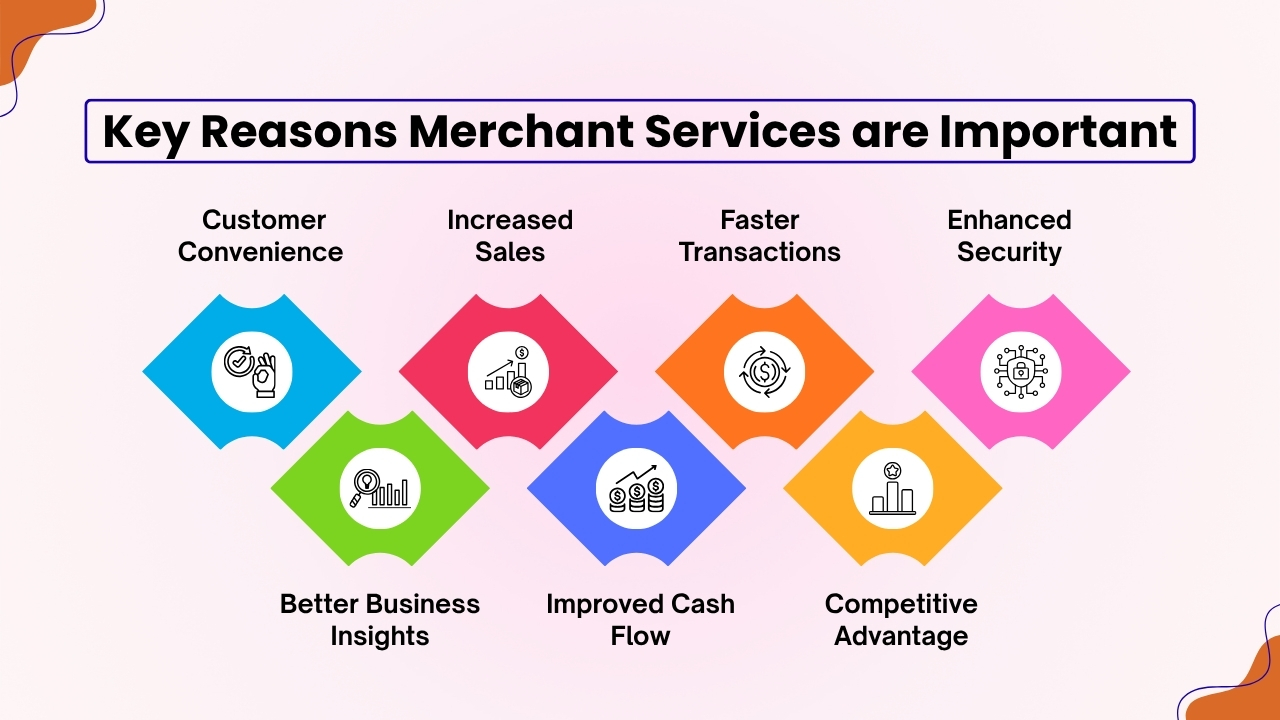
Key Reasons Merchant Services are Important
1. Customer Convenience
Customers expect flexibility of using different payment methods which includes cards, mobile wallets, or online digital options. Merchant services help businesses to provide multiple payment options to customers which makes the checkout process faster and convenient.
Providing such flexibility while making payment reduces friction which increases customer satisfaction, encourages more customers to complete purchases without any hesitation or delay.
2. Increased Sales
Merchant services help businesses to increase sales by making payments quick and convenient. Because customers who use cards or digital wallets usually spend more than making payments with cash.
Easy payment options motivate customers to make impulse purchases, reduce cart abandonments, and create a smoother buying experience for customers which leads to higher overall revenue.
3. Faster Transactions
Implementing electronic payments makes the checkout process quicker than while making payments with cash. Faster payment transactions reduce long queues, which saves time for customers and staff and improves daily efficiency.
Enabling faster transactions helps to provide a smoother shopping experience for customers which helps businesses to serve more customers and increases customer satisfaction during busy hours.
Also Read: Hospitality and Merchant Services for Hotel And Resorts
4. Enhanced Security
Merchant services use advanced security tools such as encryption, tokenization, and fraud detection to protect sensitive payment data of customers.
Implementing these features reduces the risk of data breaches, unauthorized transactions, and financial loss, that helps businesses to operate securely while establishing customer trust and confidence in every transaction.
5. Better Business Insights
Merchant service solutions also include reporting and analytics tools that give businesses a deeper insight into their daily operations.
It helps to track sales, identify trends, understand customer buying habits, and track results, which allows business owners to make smarter decisions and improve overall operations effectively.
6. Improved Cash Flow
Electronic payments are usually faster than traditional payment methods because the funds are usually deposited into the business account within a short time.
When businesses have quicker access to money, it helps businesses to manage expenses, plan finances more effectively, maintain steady cash flow, and support smoother day-to-day operations.
7. Competitive Advantage
Offering modern and convenient payment options helps businesses to have a competitive advantage in a market.
Offering flexible payment methods to customers helps businesses to attract more customers, develop loyalty, and improve customer trust, which make their marketing position stronger and encourage repeat business for long-term success.
Also Read: Small Business Inventory Tracking
Key Components of Merchant Services
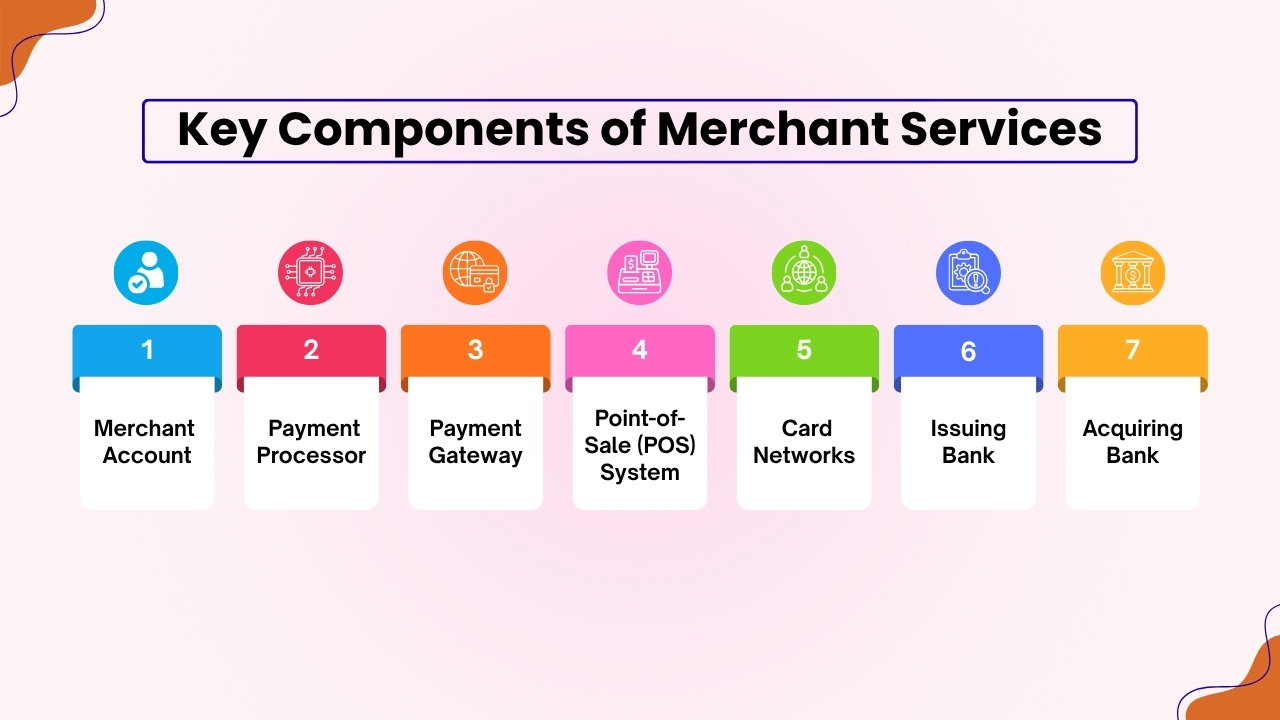
Merchant services are not just a single tool rather it is a collection of multiple interconnected components. Where each component plays a crucial role in ensuring that payment transactions are processed smoothly, securely, and effectively.
It is essential to understand the components of merchant services which help businesses to make better decisions, resolve their concerns instantly, and optimize their payment systems for better performance.
Whenever a customer makes a payment in-store or online, several systems work together in seconds. Features like authorization, settlement, each component helps to complete the transaction smoothly.
Below are the important components of merchant services:
1. Merchant Account
A merchant account is a specialized bank account that allows businesses to accept card payments. This account holds funds from transactions on a temporary basis before transferring them to the main business account.
A merchant account on a temporary basis holds approved transaction funds, and then manages the payment flow securely. It then transfers the money to the business’s main bank account within 1-3 business days. This setup reduces risks and ensures proper handling of electronic payments.
2. Payment Processor
The payment processor acts as the foundation of the transaction process. It connects the issuing bank which is the customer’s bank with the acquiring bank which is the business bank.
A payment processor verifies transaction details. The process involves sending authorization requests, verifying whether the requested amount is available in the account, and ensuring that each payment is completed accurately, securely, and effectively between the customer and business.
This process ensures that transactions are either approved or declined quickly then manages the settlement process.
Also Read: Payment Gateways Vs Payment Processor
3. Payment Gateway
A payment gateway is an essential component for online transactions. This process involves transferring payment data from the customer account to the payment processor.
This gateway encrypts sensitive payment information, and then securely sends transaction data for authorization and then quickly returns whether the response is approved or declined to complete online payments safely and effectively.
Due to features like SSL encryption and tokenization, payment gateways ensure that secure and seamless digital payments are implemented.
4. Point-of-Sale (POS) System
A POS system is used in physical stores to process payments and manage operations. Modern POS systems offer much more than just collecting payments.
It accepts card, cash, and contactless payments, tracks inventory in real time, generates sales reports, and stores customer data to support loyalty programs and smoother business operations. These systems improve checkout speed and improve the overall customer experience.
Also Read: How to Choose the Right Point of Sale System for Business
5. Card Networks
Card networks like Visa, Mastercard, American Express, and RuPay act as intermediaries between banks.
They set payment standards, route transaction data between issuing and acquiring banks, and ensure secure communication throughout the payment process helping transactions move smoothly, safely, and efficiently across the system.They provide the infrastructure that allows global payment acceptance.
6. Issuing Bank
The issuing bank is the customer’s bank which provides the credit or debit card. This issuing bank will decide whether a transaction will be approved or rejected.
This issuing bank receives authorization requests, which then checks whether available bank or credit approves or declines transactions. Then the fund is transferred when the payment is successfully authorized. This process plays an important role in detecting fraud and implementing security.
7. Acquiring Bank
The acquiring bank, or merchant’s bank, processes payment on behalf of the business. This bank manages the merchant account that receives approved transaction funds, settles payment into the business account, and also handles chargeback or payment disputes effectively.
It ensures that businesses receive payments accurately and on time.
How These Components Work Together
A typical transaction follows this flow:
- Customer initiates payment
- POS system or gateway captures details
- Payment processor sends request to card network
- Card network forwards it to issuing bank
- Issuing bank approves or declines
- Response is sent back through the same path
- Approved funds move to the merchant account via acquiring bank
This entire process happens within seconds, ensuring a fast and smooth experience.
How Merchant Services Work: Step-by-Step
It is essential for businesses to understand how merchant services work because it makes it easier for them to understand the process when the process is broken down into simple steps.
So whenever a customer makes a payment, several systems function together in real time to ensure that the transaction is secure, accurate, and is completed within seconds.
In this way when there is smooth coordination between processes it helps businesses to accept payments effectively and also provide a seamless experience for customers while making payment.
Below is a detailed step-by-step explanation:
Step-by-Step Process:
1. Customer Initiates Payment
The process starts when a customer selects a product or service and moves forward to make payment. Then the customer selects a payment method of his choice whether credit card, debit card, mobile wallet, or online payment system. This step focuses on offering a more convenient and flexible payment experience that aligns with customer expectations.
2. Payment Data Is Captured
In this step the payment data is captured by a secure device or platform. It could be a POS system, a mobile payment terminal, or an online checkout page.
Some crucial details include card number, expiration date, and transaction amount which are securely collected.
Also Read: What Payment Methods Should Retailers Accept
3. Data Is Sent to Payment Processor
After the payment data is collected, then the data is encrypted by the payment gateway which is to protect sensitive customer data. This encrypted data is then selected to the payment processor that acts as an intermediary which is essential for handling the transaction.
4. Authorization Request
In this process, the payment processor forwards the transaction request to the card network such as Visa or Mastercard. This card network routes this request to the customer’s bank in order to verify whether the transaction can be approved or failed.
5. Approval or Decline
The issuing bank then checks the customer’s account whether they have sufficient funds or not. Then it performs necessary security checks to check if there is any suspicious activity.
On the basis of the response of these checks, the bank either approves or declines the transactions which sends the response back through the same channel.
6. Transaction Completion
When the transaction is approved, then the payment gets completed quickly. If the business receives confirmation for a successful transaction, then the customer gets notification as well through a receipt, notification, or confirmation message.
Also Read: Online Transaction Security Payment Processing in Ecommerce
7. Settlement
The final step of this process is settlement, when the actual funds are transferred. The money then moves from the issuing bank to the acquiring bank and then is deposited into the merchant account. This process usually takes 1 to 3 days on the basis of the provider.
Types of Merchant Services
Merchant services are customized to fit different business models since payment needs differ based on industry, sales channels, customer preferences, and the way each business operates.
Whether physical retail stores, online platforms, and subscription-based models, merchant services offer a variety of solutions customized to specific business requirements.
Choosing the right type of service helps businesses improve efficiency, improve customer experience, and increase sales. Understanding the different types of merchant services helps businesses to select the most suitable options for their operations.
Below are the key types explained in detail:
1. In-Store Payment Processing
In-store payment processing which is the most common type of merchant service used by businesses such as retail stores, restaurants, and supermarkets.
This merchant services includes traditional POS systems, card terminals that allow customers to make payments using credit cards, debit cards, or contactless payment methods.
In-store payment processing uses POS machines, card readers which support chips. It includes swipe and tap payments which is usually a practical solution for retail stores and physical store businesses.
2. Online Payment Processing
Online payment processing works well for eCommerce businesses and service providers as it operates through websites or mobile apps. This merchant services uses payment gateways to accept digital payments securely.
This allows businesses to accept payment through websites and apps. It supports payment methods such as cards, net banking, and digital wallets which ensures transactions that remain secure through encryption and protection.
Also Read: Why Businesses Get Rejected for Online Merchant Accounts
3. Mobile Payment Solutions
Mobile payment solutions help businesses to accept payments through smartphones or tables. This type of merchant services are mostly used by small businesses or delivery services.
These solutions turn smartphones into payment terminals which support QR codes and mobile wallets. It works especially well for field services, delivery businesses.
4. Recurring Billing Services
Recurring billing is usually designed for subscription-based businesses such as gyms, and membership services. It involves an amount being deducted from the customer’s account at regular intervals.
It usually automates both monthly or yearly payments which reduces the requirement for manual invoicing that helps businesses to maintain regular cash flow through timely and predictable customer charges.
5. Virtual Terminals
Virtual terminals involve processing payments by manually entering card details into a secure system. This type of merchant service works well for phone orders or mail orders.
It allows businesses to process without using a physical card, which makes them beneficial for remote transactions. It helps staff to accept payments securely through a web browser.
6. Contactless Payments
Contactless payments use NFC(Near Field Communication) technology which allows tap-to-tap transactions. Customers just have to simply tap a card or mobile device to complete a purchase.
This offers fast and convenient transactions which supports mobile wallets and smart devices, and reduces physical contact. It helps businesses to improve hygiene, speed, and customer checkout convenience.
Also Read: Smart Payment Solution for Gaming and Esports
Benefits of Merchant Services
Merchant services are some powerful tools for businesses which help them to manage payments effectively and also improve operations.
In a quickly changing digital economy, having reliable and flexible payment solutions is essential for business growth, customer satisfaction, and financial stability.
Whether enabling faster transactions or global expansion, merchant services provide many benefits that help businesses to remain competitive.
Adopting modern merchant services helps businesses to streamline payment processes which reduces manual work and offer a seamless experience for customers.
Below are the major advantages of merchants:
1. Improved Cash Flow
One of the advantages of merchant services is it allows faster access to funds. As the electronic payments process instantly, the funds are deposited into the business account within a few days.
It helps to reduce delays because of cash handling which creates a stable and predictable cash flow that helps businesses to manage expenses, daily operations, and financial planning efficiently.
2. Scalability
Merchant services are beneficial while you are expanding your business. Even if you are running a small startup or large enterprise, these systems handle transaction volumes and support new payment technologies.
It supports business expansion by enabling them to handle growing transaction volumes easily and integrate new payment methods instantly that helps businesses to grow efficiently while meeting changing customer expectations.
3. Global Reach
With merchant services, businesses will be able to accept payments from customers around the world that gives opportunities to expand into international markets.
As merchant services accept multiple services, it supports global card networks and payment methods which helps businesses to reach international customers that helps them to expand their customer base beyond local and regional markets.
4. Automation
Merchant services enable automation which saves time and reduces human error. It automates many processes such as billing, reporting, and reconciliation.
This reduces manual work and improves the accuracy of financial records and streamlines daily operations that helps businesses to save time, reduce errors, and run payment processes effectively.
5. Better Customer Experience
Offering multiple payment options increases convenience for customers. By enabling faster and smoother transactions it often leads to higher customer satisfaction and repeat business.
Merchant services offer flexible payment options that speed up the checkout process, and help build customer trust and loyalty by building a smoother and convenient payment experience.
Merchant Services for Different Business Types
Merchant services are designed to meet the unique requirements of different types of businesses. Each industry functions differently, while selecting the right payment solutions can improve efficiency, customer experience, and overall growth.
Whether you are running a small startup or large enterprises, merchant services can be customized for matching specific requirements of operations.
Understanding this solutions works well for your business type which helps you make smarter decisions and optimize your payment systems.
Below are the main types of businesses and the merchant services they typically require:
1. Small Businesses
Small businesses usually require simple and affordable payment solutions which can be easily set up and managed. These businesses usually benefit due to mobile card readers, basic POS systems, and affordable, flexible pricing options that makes daily payment processing simple and cost-effective.
2. E-commerce Businesses
Online businesses require secure and reliable systems while handling digital transactions. It uses payment gateways, strong fraud protection, data encryption, and also supports international payments and currencies that process transactions securely and expand globally.
Also Read: Smart POS Systems The Secret of Faster Checkout and Happier Customers
3. Restaurants
Restaurants require specialized POS systems customized to a fast-paced service environment. They benefit from POS systems with table management, order tracking, tipping, split billing, and integration with kitchen and inventory systems for smoother operations.
4. Service Providers
Service-based businesses focus on invoicing and remote payment solutions. They benefit from digital invoicing, payment links, virtual terminals for remote payments, and recurring billing tools which simplify collections and support consistent revenue.
5. Large Enterprises
Large organizations require advanced and scalable payment solutions to manage high transaction volumes. Large enterprises require multi-location payment management, advanced analytics and reporting tools, and custom integrations with business systems to streamline operations, gain insights, and handle complex payment workflows.
Conclusion
Merchant services play a crucial role in modern business operations as it enables companies to accept, process, and manage payments effectively. While customer preferences keep shifting towards digital and contactless payments, it is essential to have the right merchant service solution for having a competitive advantage and meeting evolving customer expectations.
Whether merchant accounts, payment process, gateways, POS systems, each component works together ensuring secure and seamless transactions. Understanding how these components work helps businesses to make informed decisions, reduce risks, and optimize their payments.
Whether you are running a small business using mobile payment tools or a large enterprise managing high transaction volumes, merchant service provides the flexibility and scalability required for businesses to expand.
Merchant services also have other major advantages like faster cash flow, improved security, automation, and valuable business insights. These features not just improve operational efficiency rather also contribute to better customer experiences and stronger brand trust.
In today’s digital economy, businesses that adopt reliable and advanced merchant services are better positioned for long-term success.
By choosing the right provider and solutions, companies can streamline their operations, increase revenue opportunities, and deliver convenient, secure, and efficient payment experiences that keep customers coming back.
If you still have any query about what are merchant services and how they work for businesses then you may book a free demo at Ace Merchant solutions and we are more than happy to assist you.