
In 2026, inventory tracking for small businesses is essential. Due to increasing operational costs, competition, and customer demand, businesses can no longer manually track their inventory.
A modern inventory management system offers insights in real-time that ensures that their businesses remain profitable and efficient.
So even if you run a retail store, restaurant, pharmacy, accurate stock management is essential to protect cash flow, customer demand, and enhance overall business performance.
When poor inventory tracking often result in overstocking, stockouts, and lost sales. While implementing the right inventory tracking software ensures optimized stock levels, low storage costs.
You can also integrate cloud-based inventory systems with POS systems, accounting software, and online sales channels.
Other features like real-time stock updates, barcode scanning, automated purchase orders, multi-location inventory management, and AI-powered demand forecasting helps businesses to execute their operations confidently.
These tools help businesses to simplify daily operations and also improve financial reporting and long-term planning.
This blog will walk you through how a small business can track inventory effectively, include essential features, the most key KPIs, and set up inventory tracking.
Understanding the right inventory tracking tools, small businesses can reduce waste, streamline operations, and develop a scalable system which ensures long-term success.
Also Read: How to Manage Small Business Efficiently Using Modern Payment Systems
Why Inventory Tracking Matters More Than Ever in 2026
Businesses today are operating in a rapid, highly competitive market with digital systems and real-time data. Small businesses operate across several channels and different locations.
Hence, small businesses have to manage omnichannel selling across physical stores, eCommerce websites, online marketplaces, social media stores.
Customers now require visibility into real-time, smooth checkout, quick delivery, while small businesses have to operate under tighter margins, changing supplier costs, and unpredictable supply chain disruptions.
In such a complex landscape, real-time inventory tracking is essential. Without accurately tracking inventory, businesses can oversell online, frustrate customers, or fail to reorder products on time.
Any error in inventory tracking can lead to stockouts which can instantly damage brand reputation and business profits. Modern inventory systems offer centralized dashboards which sync stock counts from all locations that ensure consistency and control in business operations.
Also Read: Top 5 Features Retailer Should look into Modern Payment Terminal
Key Benefits of Modern Inventory Management
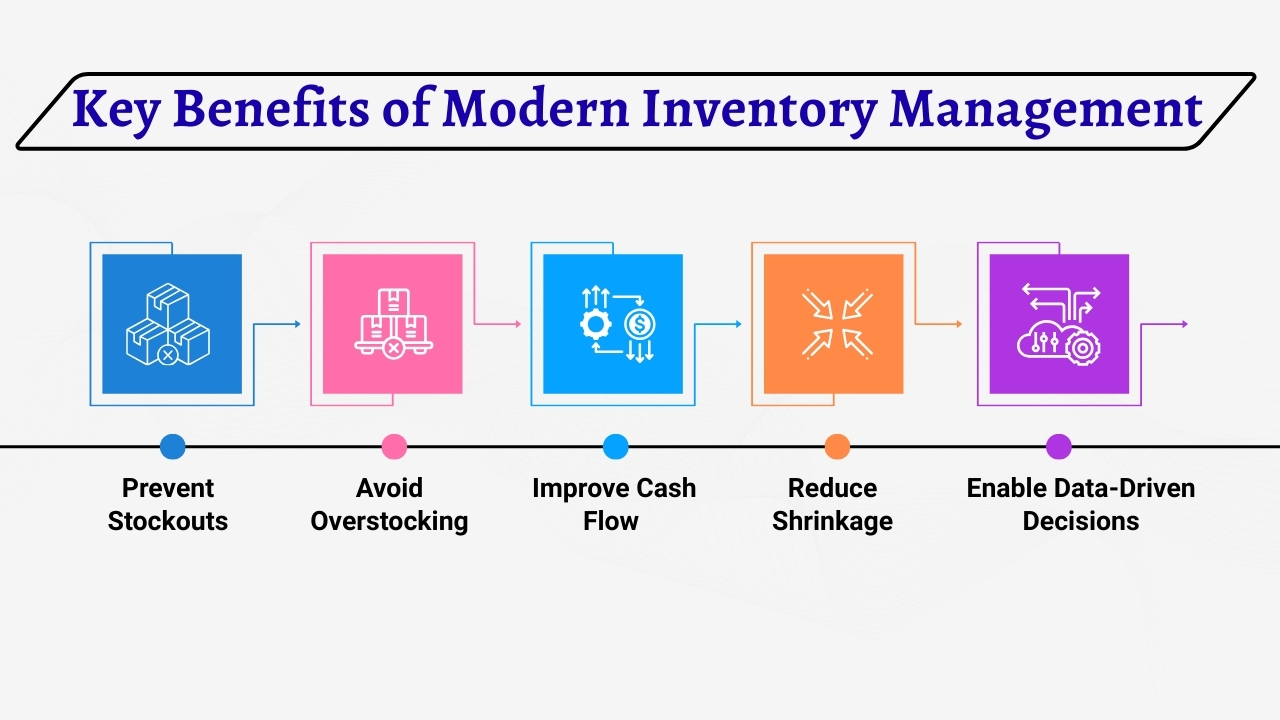
1. Prevent Stockouts
If businesses run out of high-demand products can often cause instant revenue loss and frustrate customers. In competitive markets, such stockouts may result in customers switching to alternative brands. While automated low-stock alerts and smart reordering systems help businesses to restock products on time and ensure consistent availability of products.
2. Avoid Overstocking
Excess stocking of inventory can often tie up working capital which could be otherwise used for marketing, expansion, or operational improvements. Overstocking also increases storage space, insurance, and stock handling costs. While advanced forecasting tools help businesses to ensure right stock levels.
3. Improve Cash Flow
Inventory directly impacts liquidity. Balancing the right amount of inventory helps businesses to unnecessarily invest in unsold goods. While real-time tracking helps businesses to plan stock purchases efficiently and maintain good cash flow.
4. Reduce Shrinkage
Shrinkage due to theft, product damage, or administrative errors can reduce profit margins. While barcode scanning, audit trails, and automated discrepancy reports help businesses to improve accountability and prevent losses.
5. Enable Data-Driven Decisions
Modern inventory systems offer insights into sales trends, seasonal demand, and product performance. Accurate data helps businesses to predict demand, optimize inventory tracking, negotiate better supplier terms, and increase profits.
Also Read: How to Build a Payment Franchise With Ace Merchant Processing
Types of Inventory Tracking Systems in 2026
Today businesses can choose from multiple inventory tracking systems based on their size, industry, budget, and operational complexity. Choosing the right system is essential for maintaining accuracy, efficiency, and supporting long-term growth.
1. Manual Inventory Tracking
Manual inventory tracking involves using spreadsheets, notebooks, printed stock sheets, and regular physical stock counts. Most small businesses start inventory tracking with manual inventory tracking method as it is both simple and inexpensive.
Pros:
- Low cost to implement
- Easy to start without technical setup
- No software subscription fees
Cons:
- High chances of error due to manual data entry
- Time-consuming and requires labor
- Difficult to manage as the business grows
- No real-time visibility
- Limited reporting and forecasting capabilities
While manual systems may work only on a temporary basis, they quickly become inefficient when product variety and sales volume increase. In 2026, depending only on manual tracking is not sustainable for growing businesses.
2. Barcode-Based Inventory Systems
Barcode systems use unique product codes printed on labels which are scanned during checkout, stock intake, and inventory transfers. Each scan automatically updates the inventory database in real time.
Benefits:
- Accurate and instant stock updates
- Faster checkout process
- Reduced human error
- Improved inventory control
- Easy product identification
Ideal for:
- Retail stores
- Supermarkets
- Pharmacies
- Small warehouses
Barcode systems are affordable, easy to implement, and highly effective for small and medium-sized businesses. They reduce mistakes as compared to manual tracking and offer real-time visibility into inventory.
3. RFID Inventory Tracking
RFID(Radio Frequency Identification) technology uses wireless tags in their products which helps to automatically identify, track, and update inventory data without needing to scan manually. Unlike barcodes, RFID does not do direct scanning. Rather products can be scanned in bulk using specialized readers.
Advantages:
- No manual scanning required
- Bulk inventory tracking
- Extremely high accuracy
- Faster stock audits
- Theft detection and loss prevention
RFID systems are expensive as compared to other inventory tracking tools while they are efficient for large retailers, warehouses, and businesses managing high-value products. It saves time and also improves operational speed.
4. Cloud-Based Inventory Software
Cloud inventory systems are considered an important standard in 2026. These platforms store data online and provide real-time access from any device with an internet connection.
Features:
- Real-time stock visibility
- Multi-location management
- Remote access via mobile or desktop
- Automatic software updates
- Integration with POS and accounting systems
- Advanced reporting and forecasting
Cloud-based inventory software lets businesses to track operations from anywhere allowing them to manage multiple locations, and maintain stock levels synchronized on both online and offline channels. This flexibility makes implementing cloud systems best for modern, growth-focused businesses.
Selecting the right inventory tracking system depends on your operational requirements, budget, and scalability goals. In 2026, businesses that invest in cloud-powered systems will have a competitive advantage.
Also Read: How to Choose the Right POS System for Your Business
Essential Features to Look for in 2026
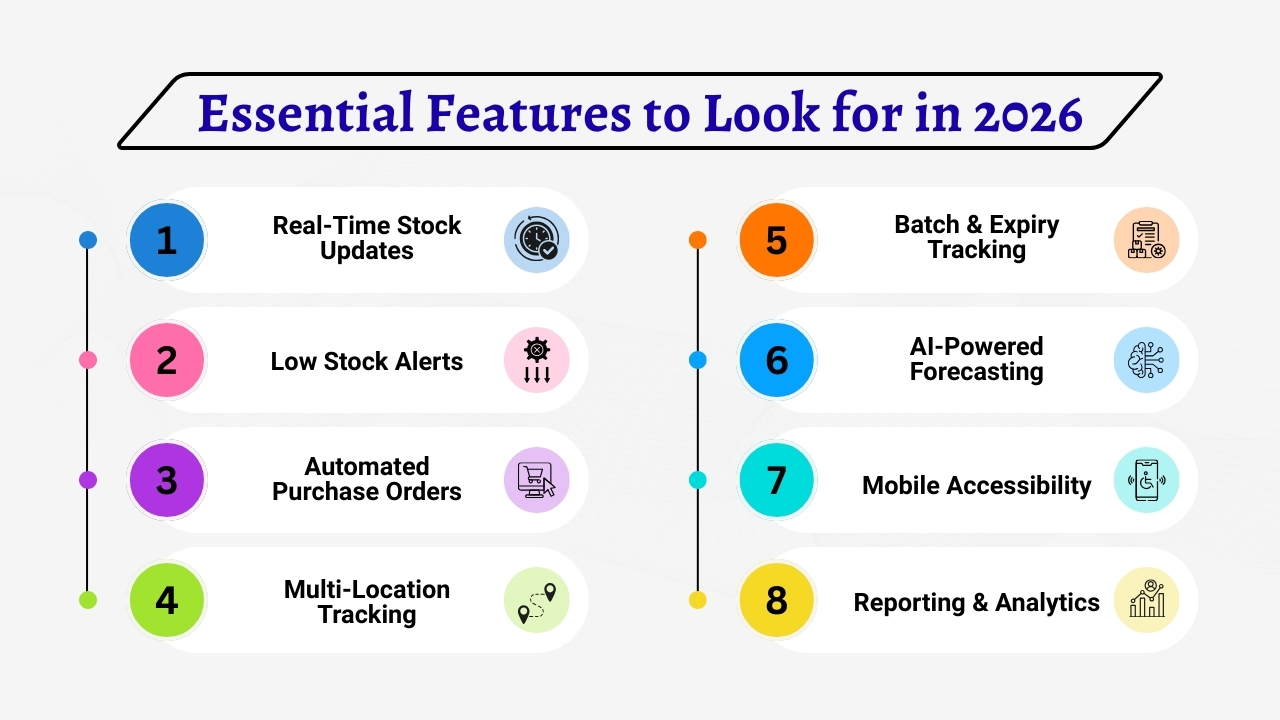
When selecting inventory software, prioritize:
1. Real-Time Stock Updates
Modern inventory systems must instantly sync stock levels across all channels whether in-store POS, eCommerce systems, and marketplaces.
When businesses have visibility into stock levels in real-time, then it prevents chances of overselling, stock discrepancies, and ensures an accurate amount of inventory is available at all times which is essential for growing retail and multi-chain businesses.
2. Low Stock Alerts
Automating low-stock alerts helps businesses to avoid chances of stockouts and lost sales. Modern inventory tracking systems should allow businesses to set stock limits and send low-stock alerts via email, dashboard notifications, or mobile application. Proactively sending alerts to businesses helps them to restock products whenever needed in real time and ensures smooth operations.
3. Automated Purchase Orders
Advanced inventory software helps businesses to automatically generate purchase orders, sales trends, and demand trends. It helps to reduce manual errors and workload, and ensures right stock levels are available across all locations.
4. Multi-Location Tracking
For businesses operational in multiple locations, a centralized inventory management system is essential. A centralized dashboard must reveal stock levels, stock transfers, and performance metrics across all locations in real time, improving coordination across all locations.
5. Batch & Expiry Tracking
Industries like food, pharmaceuticals, and cosmetics need to implement precise batch management. Modern inventory systems should track batch numbers, manufacturing dates, and expiry dates to ensure compliance, reduce waste, and maintain product safety standards.
6. AI-Powered Forecasting
Artificial intelligence enhances demand planning as it helps businesses to analyze past sales data, seasonal patterns, and market trends. Predictive insights help businesses to be prepared for busy hours, avoid stockouts, and optimize their purchasing decisions.
7. Mobile Accessibility
In today’s times, inventory management cannot be done only on desktops. Mobile apps or responsive dashboards lets managers and staff update stock, scan barcodes, and track overall performance from their smartphones providing flexibility and productivity.
8. Reporting & Analytics
Detailed reporting tools offer insights into important performance indicators, profit margins, inventory turnover, and product performance. Data-driven analytics helps businesses to make better strategic decisions and planning for long-term growth.
Also Read: Smart POS System the Secret to Faster Checkouts
Inventory Tracking Methods Explained
Choosing the right inventory tracking method is essential for businesses as it provides them accurate financial reporting, cost control, and operational efficiency.
Different inventory tracking methods impact profit margins, tax calculations and stock management strategies.
Below are the three most commonly used inventory tracking methods explained in detail.
1. FIFO (First In, First Out)
FIFO involves selling the oldest inventory that is used or sold first. This method assumes that products purchased or manufactured first must be the first one to leave the warehouse. It is essential for businesses dealing with perishable goods like food, beverages, cosmetics, and pharmaceuticals.
As older stock is sold out first, FIFO reduces the chances of product spoilage or product expiration. During times of rise in prices, FIFO usually results in lower cost of goods sold and higher profits because older, lower-cost inventory is sold first. Additionally FIFO aligns with the natural flow with which physical goods should be handled in many industries.
2. LIFO (Last In, First Out)
LIFO assumes that the most recent purchases inventory is sold first. It is often used in specific accounting cases, especially during times of inflation periods.
When prices increase, the LIFO method reports a higher cost of goods sold because it assigns the most recently purchased/ higher cost inventory to be sold first. This reduces taxable income in certain regions.
However, LIFO may not show the accurate movement of goods and is not allowed under some international accounting standards. While this method is common in manufacturing and large-scale warehouses.
3. Weighted Average Cost
The Weighted Average Cost method calculates the average cost of all available inventory items during a certain period and uses that average cost to determine cost of goods sold. Instead of tracking individual purchase batches separately, this approach averages costs to reduce the impact of price fluctuations.
This method simplifies accounting and works well for businesses dealing with large volumes of similar products where tracking individual purchase costs would be complex.
Also Read: Online Transaction Security Payment Processing in Ecommerce
Inventory KPIs Every Small Business Should Monitor
Tracking the right inventory performance metrics is important for maintaining good cash flow, reducing waste, and increasing profitability. If inventory performance is not measured with clear data, businesses risk overstocking, stockouts, and reduced margins.
Below are the important KPIs that every small business should regularly monitor.
1. Inventory Turnover Ratio
The Inventory Turnover Ratio measures the count of times inventory is sold and replaced within a certain period, like annually. A higher turnover ratio indicates good sales and efficient stock management, while a low turnover ratio indicates overstock or weak demand. Monitoring this KPI is essential as it helps to maintain optimal stock levels and prevent holding excess capital in unsold goods.
2. Sell-Through Rate
Sell-Through Rate is the percentage of stock sold during a certain time period compared to the amount received. It is useful for seasonal products and promotional campaigns. A strong sell-through rate indicates effective alignment of both prices and demand, while a low rate indicates poor product performance or over-purchasing.
3. Carrying Cost
Carrying Cost is the total expense of holding inventory which includes storage, insurance, depreciation, warehousing, and opportunity counts. If there are high carrying costs then it may reduce profits and cash flow. Keeping this carrying cost metric under control ensures that expenses made for investments remain efficient and match with the business revenue.
4. Gross Margin Return on Investment (GMROI)
Gross Margin Return on Investment measures the profit earned for every dollar invested in inventory. It helps determine whether products generate sufficient returns relative to their cost. A higher GMROI indicates strong profitability and efficient inventory use.
5. Stockout Rate
Stockout Rate tracks how often items are unavailable when customers want to purchase them. Frequent stockouts lead to lost sales and reduced customer satisfaction. Monitoring this metric helps prevent revenue loss.
Regular monitoring of these KPIs empowers small businesses to make data-driven decisions, improve stock efficiency, and increase overall profitability.
Also Read: Payment Gateway Vs Payment Processor
How Modern POS Systems Improve Inventory Tracking
Modern Point-of-Sale(POS) systems have transformed the way businesses manage inventory. Instead of depending on manual updates and periodic stock counts, as today’s systems automatically synchronize sales and inventory in real time. This automation significantly reduces errors and improves operational efficiency.
How the Process Works
When a customer makes a purchase, a modern POS system automatically updates the count of inventory within seconds. First, the product is scanned, when the barcode scanner instantly extracts product details from the database.
Then the sale is processed while the POS system calculates totals, taxes, and discounts instantly. Once payment is confirmed, the stock count reduces instantly, updating inventory in real time.
At the same time, revenue is also recorded in reports and sales dashboards for accurate financial tracking. Ultimately, reorder levels are monitored consistently and whenever stock goes below a preset minimum count, then the system sends alerts or automatically generates purchase orders. It keeps inventory levels accurate across both in-store and online channels.
Key Benefits of POS-Integrated Inventory
1. No Manual Adjustments
POS-integrated inventory systems automatically update stock counts each time a sale is completed. This removes the need for updating stocks manually which are often time-consuming and also at risk of human error. While automatically updating inventory helps to save valuable staff time and ensures inventory data is accurate without any regular supervision.
2. Accurate Financial Reporting
As sales and inventory data are interconnected, financial records are updated instantly. It allows businesses to calculate revenue, cost of goods sold, and profits clearly. Accurate financial data is essential to improve budgeting, forecasting, and financial transparency.
3. Seamless Accounting Integration
Modern POS systems can integrate smoothly with accounting software, thereby syncing sales expenses and inventory data. It helps to reduce duplicate data entries, reduce reconciliation errors, and streamline bookkeeping processes which makes tax preparation and compliance easier.
Inventory Tracking for Different Business Types
Effective inventory tracking varies on the basis of their business type. Each industry has distinct operational requirements, which makes personalized solutions essential for efficiency and compliance.
1. Retail Stores
Retail businesses require detailed SKU management to track thousands of products efficiently. Variant tracking like size, color, or style helps retailers to be prepared for busy sales hours and avoid overstocking or understocking of items.
2. Restaurants
Restaurants depend on tracking ingredient-level instead of finished products. Inventory systems should also automate recipe-based deductions, so that systems automatically ingredient quantities each time when a dish is sold. Waste monitoring is also essential to control food expenses, reduce spoilage, and improve business profits.
3. Pharmacies
Pharmacies require batch tracking and expiry monitoring to ensure product safety. Compliance with healthcare regulations is mandatory that make regulatory reporting and traceability important features. Each business type requires a personalized inventory approach to ensure operational accuracy and sustainable growth.
Also Read: Which Payment Methods Should Retailer Accept
Implementing an Inventory Tracking System
Implementing an effective inventory tracking system is an essential step that businesses can take to improve efficiency, reduce losses, and increase profitability.
Step 1: Conduct a Physical Audit
Before implementing a new system, it is essential that you conduct a complete physical stock audit. It provides an accurate foundation for your inventory records.
Ensure that you count every product like items in storage rooms, shelves, warehouses. Verify quantities of items carefully and identify damaged, expired, or obsolete items. Make sure that you conduct the audit during non-business hours to prevent any inconsistencies.
Conducting a detailed audit ensures that the data entered in your new system reveals actual stock counts. If you avoid this step can often lead to inaccurate reporting.
Step 2: Clean Your Product Database
After having the right count of stock, the next step is to review your product database. Ensure you remove duplicate entries, outdated SKUs, discontinued products, and inconsistent naming formats.
Create a consistent product data standard so that every product item uses the same description format, units of measurement, barcode numbers, and categories across your system. Because clear and organized data improves system performance and reporting accuracy.
This is also the right time to categorize products by brand, department, supplier, or product type. A clean database ensures that there are less chances of confusion and inventory management is done effectively.
Step 3: Select the Right Software
Choosing the right inventory tracking system for your business is essential. Look for scalable, cloud-based systems which grow with your business.
Key features to consider include:
- Real-time stock updates
- Multi-location tracking
- Barcode scanning support
- Automated purchase orders
- Reporting and analytics
- Integration capabilities
Cloud-based systems provide remote access, automatic updates, and more data security. Avoid selecting software only on the basis of price, rather focus on systems that provide long-term value, flexibility, and ease of use.
Step 4: Train Employees
Even the best software will fail if there is no proper training provided to employees. Because it is essential for employees to understand how to use the system correctly.
Provide structure training sessions covering:
- Barcode scanning procedures
- Stock receiving processes
- Handling returns
- Adjusting damaged or expired stock
- Running reports
Ensure that you establish clear scanning protocols so that every sale, return, or stock movement is recorded accurately. Also encourage staff to report issues instantly to avoid data inconsistencies.
Well-trained employees reduce chances of errors, increase efficiency, and ensure maximum return on software investment.
Step 5: Set Reorder Points
Reorder points are minimum stock limits which initiate replenishment. Analyze past sales data to find reorder levels for each product. Check lead times, supplier reliability, seasonal demand, and safety stock requirements.
For instance, best-selling items should have higher reorder limits, while slow-selling products may require tighter control to avoid overstocking. Automating low-stock alerts or purchase order generation can prevent stockouts and lost sales.
Proper reorder planning helps to improve cash flow and ensures consistent availability of products.
Step 6: Integrate Systems
An inventory system should not operate separately. Instead integrating your inventory system with other business systems helps to improve efficiency and reduces duplication.
Connect your inventory software with:
- POS systems for automatic stock deduction
- Accounting software for real-time financial reporting
- Supplier platforms for streamlined purchasing
- eCommerce platforms for multi-channel synchronization
Integrating with other systems ensures that your data flows smoothly across different departments, reduces errors and manual entry. While a centralized system supports making better decisions and increasing operational transparency.
Step 7: Monitor and Adjust
Implementation does not end after setup. Because continuous monitoring is crucial for ensuring long-term success.
Track key performance indicators(KPIs) such as:
- Inventory turnover ratio
- Sell-through rate
- Carrying cost
- Stockout rate
- Gross margin return on investment(GMROI)
It is essential to regularly review reports to identify the items that are not best-sellers, overstock issues, or purchasing inefficiencies. Accordingly adjust reorder points, supplier strategies, or pricing whenever required.
Ensure that you schedule periodic stock audits on a monthly, quarterly, or annually basis of your business size and complexity. Continuous improvement ensures that your system remains aligned with business growth.
Multi-Location Inventory Management
Businesses functioning across multiple locations or warehouses often face inventory imbalances, where one location may overstock products while other locations experience inventory shortages.
Without proper coordination, it can often lead to lost sales causing expenses and inefficient stock management.
Modern cloud-based inventory systems solve this problem by offering centralized tracking across all branches. This allows managers to view stock levels in real-time from a single dashboard, ensuring that they have complete visibility of inventory at each location.
These systems support inter-branch transfers that allow businesses to move stock from one location or branch to another on the basis of demand. It helps businesses to avoid unnecessary reordering and increases stock optimization.
On top of that location-specific reporting helps to analyze performance by branch, identifying best-selling and slow-moving items in each location.
Conclusion
In 2026, effective inventory tracking is no longer optional; instead it drives profits, efficiency, and long-term growth.
Due to rise in customer expectations, multi-channel selling, and operational costs, small businesses require accurate, real-time data insights to remain competitive.
Modern inventory systems with cloud technology, automation, and AI-driven forecasting offer the visibility and control essential for smarter decision making.
Implementing organized processes like conducting physical audits, cleaning product databases, setting reorder points, and integrating POS and accounting systems, helps small businesses to reduce errors caused by manual inventory tracking and also reduce costly stock discrepancies.
Tracking important performance indicators like inventory turnover, sell-through rate, and stockout rate ensures that businesses have optimal stock levels and strong cash flow.
Whether you run a retail store, restaurant, or pharmacy, customized inventory solutions help to avoid overstocking, reduce waste, and improve customer satisfaction.
Finally, a well-managed inventory system helps small businesses to expand confidently, respond to market changes instantly, and build data-driven operations for the future.
If you still have any query about Small Business Inventory tracking then you may write to us at Ace Merchant Processing solutions and we are more than happy to assist you.