
In today’s fast evolving retail environment, the real challenge is not deciding to accept digital payments rather it’s choosing the right mix of payment methods to match how customers want to pay and keep your business ahead.
Because shoppers now arrive at the checkout many payment methods based on their convenience, security, speed. Some expect to tap a phone, while others want to use a card, and many still depend on cash.
Retailers that fail to accommodate these payment methods risk creating concerns at the most crucial moment of the customer journey – while making payment.
Payment options influence brand trust because an outdated checkout creates inconvenience and unreliable but a modern and flexible payment setup indicates professionalism and customer-first experience.
The payment methods that you support don’t just improve the customer experience, but also influence processing costs, daily checkout speed, fraud risk, and even average order value.
For instance, faster payment methods move through checkout quickly and keep staff focused, while convenient digital options often make it easier for shoppers to buy on impulse or higher spend.
With the increase of contactless payments, mobile wallets, and alternative financing payment options broadened the payment sector.
As tap-to-pay, mobile wallets, and flexible financing are more common payment options, retailers have to balance convenience and compliance in security standards, privacy expectations, and regulatory requirements while deciding which payment methods to support.
A payment option that works well for a small local shop may not work for a multi-location retailer or high-volume stores.
Ultimately, retailers need a balanced payment strategy by supporting the payment options that customers prefer and also keeping processing fees, fraud risk, and operational complexity under control.
It is essential to understand the payment options that your customers prefer, align them with your business goals, and ensure they fit into a secure, scalable payment strategy.
Also Read: What is Payment Processing Software
Understanding Consumer Preferences
Consumer payment preferences have changed drastically over the last decade. From the traditional use of cash and cheques to digital payments, the way people spend money is changing rapidly.
Mobile wallets, credit cards, and even newer methods like Buy Now, Pay Later(BNPL) have reshaped the retail payment sector.
1. Trends in Payment Behavior
Shoppers increasingly depend on their smartphones to track budget, pay bills, and make purchases, so mobile wallets like Apple Pay, Google Pay, and Samsung Pay are becoming a familiar payment choice at checkout.
Recent research reports show that quickly United States customers are moving toward digital, tap-and-go payments for faster and more convenient checkout.
Supporting mobile wallets helps retailers reduce checkout friction, move customers through faster, and deliver the secure, contactless experience people expect across store, online, and pickup orders.
Also Read: Top Retail Payment Trends
2. The Rise of E-commerce
E-commerce is leading this change. Because more retailers are moving to online platforms and consumers expect to make payments via the methods that they trust.
Offering many online payment options not just improves customer satisfaction and conversion but also makes checkout quicker, smoother, and more convenient for every customer.
Essential Payment Methods for Retailers
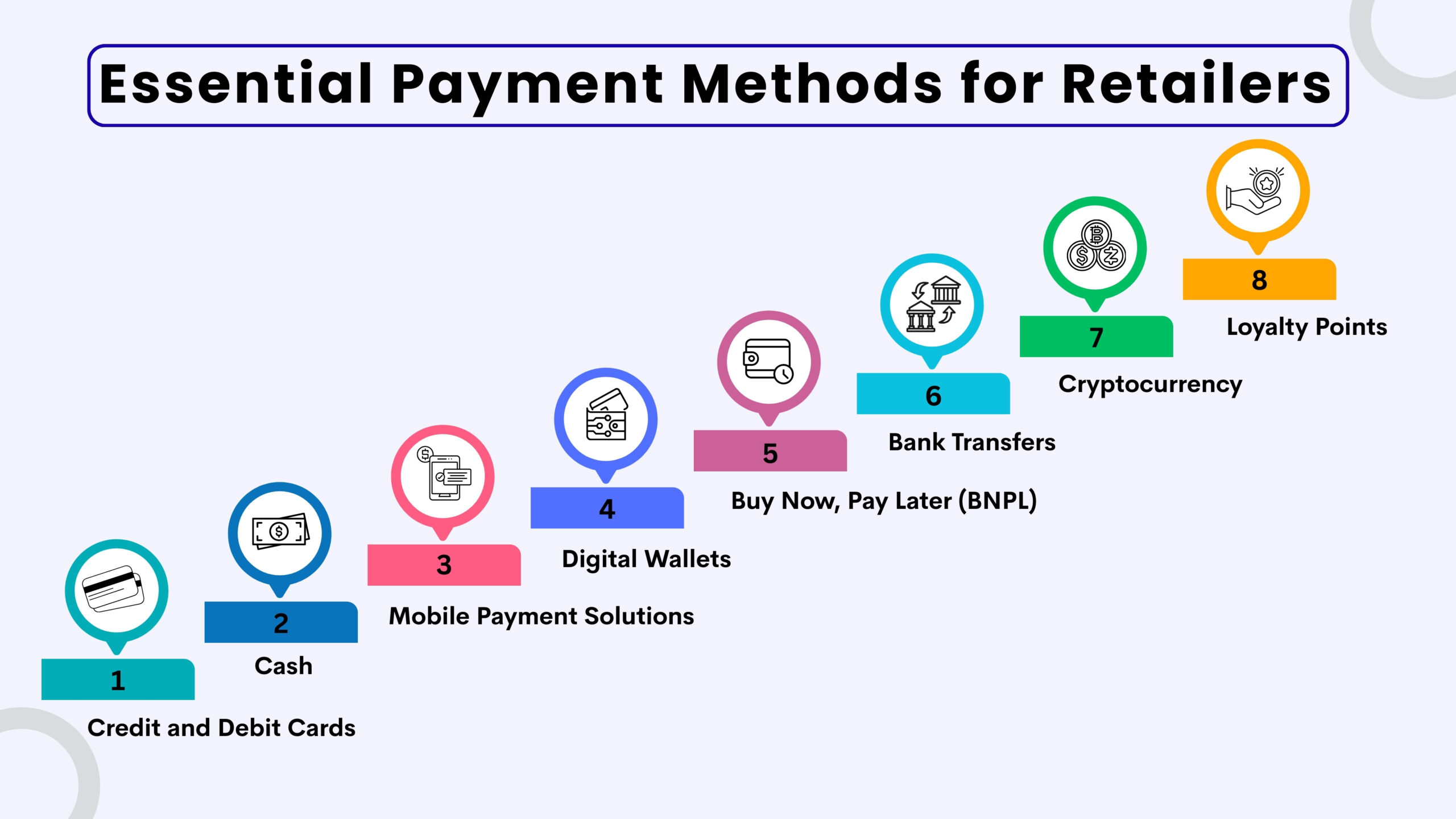
Today retailers need a payment setup that meets today’s must-have expectations while staying adaptable as new payment trends and customer habits evolve. The foundation begins with cash, which remains important for customers and helps avoid processing fees.
Next are debit and credit cards that continue to be the primary payment method for most in-store and online purchases. Tap-to-pay has become a must-have because it makes the checkout experience feel smooth, modern, and effortless.
While equally important other payment options are mobile wallets like Apple Pay, Google Pay, and Samsung Pay that improve convenience, low-friction checkout experience and stronger security through tokenization and biometric authentication.
For omnichannel and online store retailers, PayPal and other wallet-based checkout methods can increase customer conversions by building a familiar, trusted option and offering quick login-based payments.
Retailers should also consider Buy Now, Pay Later(BNPL) for higher-priced products as it will increase average order value and improve affordability without requiring customers to use traditional credit.
Finally, gift cards and store credit are valuable add-ons that drive repeat visits and build loyalty. A smart strategy is to offer the must-have payment methods first, and offer additional payment options based on your product type, average order value, and the preferences of your target audience.
1. Credit and Debit Cards
Credit and debit cards continue to be one of the most accepted and trusted payment methods in retail. Because Visa, Mastercard, and American Express are mostly used by customers in retail payment for in-store and online transactions.
Customers depend on cards everyday and expect these cards to work instantly. It is essential for retailers to accept card payments which helps to speed checkout, higher average order values, and establish a consistent payment experience across stores, websites, and mobile apps.
As they support recurring billing, quick refunds and adjustments, and clear transaction reporting, so credit and debit cards remain a foundation for smooth and efficient retail operations.
Security Considerations
Retailers must prioritize security and compliance by using payment solutions that follow PCI-DSSrules for handling, storing, processing, and transmitting card data.
Fraud remains a concern, especially for online and card-not-present transactions, but protections like EMV chip technology, end-to-end encryption, and tokenization have significantly reduced risk.
Many processors now tokenize card details by replacing real card numbers with secure tokens, so even if data is exposed, it’s far less useful to attackers.
By pairing PCI-compliant systems with real-time fraud monitoring and secure checkout best practices, retailers can accept card payments confidently while protecting customers and the business.
Also Read: Restaurant Credit Card Processing Explained
2. Cash
Cash usage for making payments is reducing in many regions but still cash plays a crucial role in retail for restaurants, local markets, where customers would consider quick and simple payments.
Cash transactions are instant, and can be done even without internet connection, has no processing fees and helps retailers to protect margins on smaller purchases.
Cash can also be useful during system outages or payment terminal issues, making it a practical “backup” option. For certain customer groups like older shoppers or people without access to cards or digital wallets for them cash remains a familiar and comfortable way to pay.
Trends:
Recent trends show that people are moving toward cashless payment with the rise of tap-to-pay cards, mobile wallets, and QR-based payments which made digital payments faster and more convenient.
In many places, the pandemic accelerated this change by increasing preference for contactless checkout and reducing comfort with physical currency.
Retailers are also experiencing operational advantages With less cash in the drawer, retailers spend less time on deposits, reduced theft risks, and simpler end-of-day reconciliation.
The smartest approach is often to accept cash where it clearly serves your customer base, while making digital payments the fastest and most encouraged option at checkout.
Also Read: Payment Gateways Vs Payment Processor
3. Mobile Payment Solutions
Mobile payment services like Apple Pay, Google Pay, and Samsung Pay give customers a fast and secure way which lets them pay directly from their smartphones or smartwatches.
Customers rather than swiping or inserting a card, they just have to simply tap their device and authenticate with Face ID, fingerprint, or a passcode that makes checkout smooth and quick.
These wallets are designed with strong security using tokenization so that the actual card number is not shared with the merchant during the transaction.
Adoption continues to grow because mobile payments feel effortless. Customers don’t need to carry a physical wallet, and many prefer the “one-touch” experience for both in-store purchases and online checkout.
For retailers, supporting mobile wallets can improve conversion, especially with younger and tech-savvy shoppers, while also lowering fraud risk compared to traditional card swipes.
As contactless becomes the default expectation, mobile payments are quickly shifting from “nice to have” to an essential part of a modern checkout experience.
Also Read: Smart Payment Solution for Gaming and Esports
4. Digital Wallets
Digital wallets like PayPal, and Amazon Pay allow customers to pay online without typing card numbers. Shoppers just have to log in and confirm the purchase in a few clicks which reduces friction on mobile devices.
Many digital wallets add more security with encrypted transactions, buyer protection policies based on the provider, and fraud monitoring.
For customers, more security and familiarity feels reassuring even while trying a new brand which makes customers feel comfortable and confident while completing the purchase.
Benefits for Retailers
Digital wallets helps retailers to improve conversions by offering a faster, more trusted checkout especially online, where shoppers often abandon carts when they feel payments are slow, confusing, or not secure.
Wallet-based payments reduce the amount of card information to be entered, which feels safer, reduces their hesitation, and helps them complete checkout faster.
Digital wallets can be helpful for international shoppers because many already have their wallet linked to local cards or bank accounts, making payment smooth across borders.
By offering digital wallets alongside cards and mobile wallets, retailers can support customers wherever they shop online, in-app, or on any device while keeping checkout secure and reassuring.
Also Read: Online Transaction Security Payment Processing in Ecommerce
5. Buy Now, Pay Later (BNPL)
Buy Now, Pay Later services allows shoppers to split their purchase payments into multiple payments with low or no interest if they make payments on time.
This option has grown quickly because customers feel simpler compared to traditional credit, with clear installments scheduled shown at checkout. This payment option is popular among young shoppers who want adaptability, predictable budgeting, and avoid credit cards.
It is commonly used for fashion, electronics, beauty, and higher-ticket items where customers may hesitate to pay the full amount upfront.
Advantages for Retailers
BNPL can reduce price concerns at checkout, as the customers have to make payments in several installments which leads to more conversions and increased average order value as customers feel comfortable while choosing premium items.
It is an attractive option for retailers as though the provider settles the full amount upfront and takes responsibility for collecting payment, often taking on the associated fraud risks.
When offered responsibly alongside cards and wallets, BNPL becomes a powerful tool for driving sales without forcing customers into traditional credit.
6. Bank Transfers
Bank transfers including ACH payments, direct debit, and wire transfers remain an important payment option for certain retail and commercial scenarios.
These payment options are used for higher-value purchases, bulk orders, and B2B transactions where customers look for reliability and payment assurance more than a fast checkout experience.
Bank transfers usually move money between accounts so they usually have lower fees than card processing that makes it a cost-effective option for high-value items.
Why Retailers Use Them
For retailers, bank transfers can significantly reduce payment costs on large transactions while also reducing chargeback risk, since transfers are harder to reverse than card payments.
They are especially useful while working with repeat customers, corporate buyers, or pre-approved accounts. However, bank transfers are usually slower than cards or wallets and require more manual reconciliation, which reduces their practicality for everyday consumer purchases.
As a result, they work best as a complementary option offered selectively for large-value or B2B sales rather than as a primary checkout method. When used strategically, bank transfers help retailers balance cost efficiency with payment security for high-value transactions.
7. Cryptocurrency
Cryptocurrency payments remain a niche option, but some retailers have started offering them to appeal to young tech-savvy customers and international buyers.
One of the advantages of cryptocurrency is global reach. It supports cross-border payments without any traditional banking rails which will simplify some international transactions.
Based on the setup and provider, cryptocurrency can reduce transaction costs and remove chargebacks because most blockchain payments are irreversible.
For innovative brands, accepting crypto currency can also act as a marketing indication that they are forward-looking.
Challenges:
Despite the advantages, cryptocurrency has practical complexities. Price instability is a major issue especially with non-stablecoin assets because the value can change significantly between the time of purchase and settlement.
Customer adoption of cryptocurrency is still limited, and many shoppers are not comfortable managing wallets, keys or blockchain confirmations. There are also compliance and regulatory considerations that differ by country and even by state, including tax, reporting, and consumer protection rules.
For most retailers, crypto works best as an optional, carefully managed payment method often through a payment processor that converts crypto to local currency instantly to reduce risk.
8. Loyalty Points
Loyalty points are an important payment option that retailers should consider focusing on repeat customers and to create long-term value.
Instead of serving as a standalone payment method, loyalty points allow customers to redeem rewards earned from previous purchases to cover future transactions fully or partially.
This creates a sense of ongoing value and gives shoppers a reason to return instead of switching to competitors.
Loyalty points can feel more satisfying than flat discounts for customers because those points add up over time and often lead to offers like free items, exclusive offers, or early access to promotions.
This approach encourages repeat visits, increases purchase frequency, and improves customer lifetime value.
Loyalty programs also provide valuable customer data, helping retailers to understand their purchase patterns, identify high-value shoppers, and develop more targeted, personalized marketing campaigns.
Challenges
The main challenge with loyalty points is to keep everything run smoothly by tracking loyalty point balances, clear redemption rules, and handling the accounting when customers use loyalty points.
With modern POS and e-commerce tools automating tracking and reporting, loyalty points can be managed with less manual work. If loyalty point tracking is executed well then they build lasting customer relationships and steady growth without depending on discounts.
Pros and Cons of Different Payment Methods
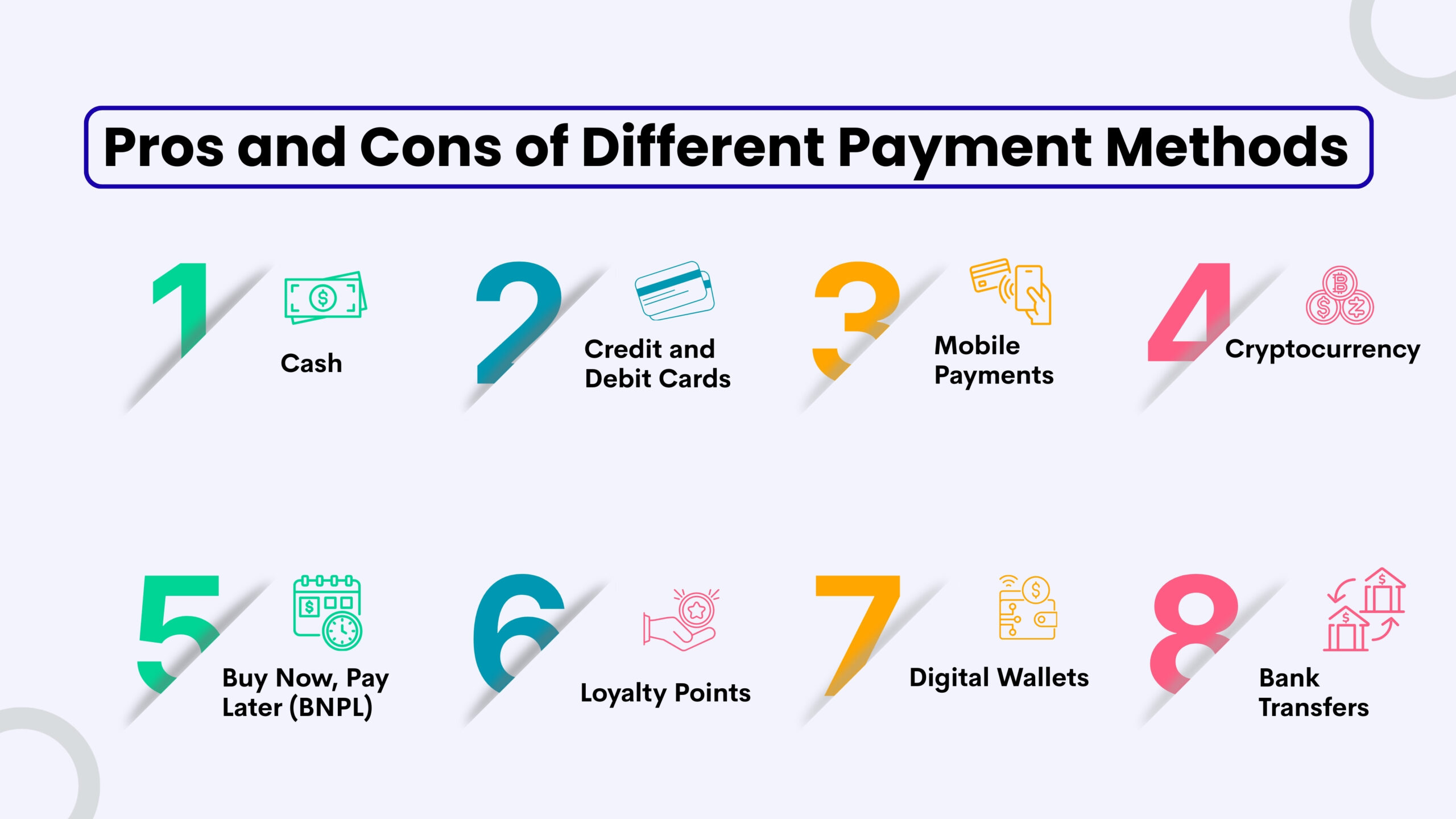
Every payment method comes with clear advantages and disadvantages. Though credit and debit cards are trusted widely by customers and are convenient , they also include processing fees and fraud risk.
Though mobile wallets offer fast, secure checkout, but require compatible devices and systems. Digital wallets improve conversion and trust online but have complexities during integration.
Buy Now, Pay Later improves average order value but can also increase fees. Bank transfers work well for high-value or B2B sales but are slower.
Cash has no processing fees but lacks data and scalability. Loyalty points improve customer retention but have complexities while tracking points. The right payment mix provides convenience, cost, and security to customers.
1. Cash
Pros:
Cash is simple and universally accepted. Cash payments can be done immediately while there are no processing fees. It is useful for small purchases and locations with no internet connectivity.
Cons:
Because customers can only carry limited cash so it may restrict purchases size. Retailers must manage secure storage, make frequent bank deposits, and face higher risks of theft or loss—both internally and externally.
2. Credit and Debit Cards
Pros:
Cards make businesses appear professional and trustworthy. They meet modern customer expectations, work well online, and deposit funds directly into business accounts without bank visits.
Cons:
While card payments are convenient, they have merchant fees and added risks like chargebacks and fraud which can be liability for retailers, and any data breach can damage customer trust.
3. Mobile Payments
Pros:
Mobile payments offer fast, convenient, and wallet-free convenience for customers. With funds generally settling in a few days and transaction data that can support reporting and marketing decisions.
Cons:
Security depends on customer device protection. Retailers may need multiple systems for different platforms and compatible hardware for in-store acceptance.
4. Cryptocurrency
Pros:
Crypto offers lower processing fees, with no international charges, and reduced fraud risk. As cryptopayments are usually irreversible, merchants must maintain control by handling refunds rather than depending on chargeback reversals.
Cons:
The challenge is that prices can fluctuate, and the accounting, tax, and reporting requirements are often complicated.Permanent transactions can increase operational effort for refunds.
5. Buy Now, Pay Later (BNPL)
Pros:
BNPL makes purchases feel more affordable upfront, due to which customers will have more access to credit that helps retailers to improve conversion rates and reduce cart abandonment.
Cons:
The drawback is higher processing fees, higher return rates, and customer service complexity when issues are handled through a third-party BNPL provider.
6. Loyalty Points
Pros:
Loyalty points lead to repeat purchases, lower customer acquisition costs, and generate useful insights which helps retailers to run targeted marketing.
Cons:
Loyalty points require ongoing management while redemptions can reduce short-term revenue when points replace cash at checkout.
7. Digital Wallets
Pros:
Customers can make payment without entering card details that makes checkout faster. It improves conversions by offering checkout through familiar, secure platforms customers already recognize.
Cons:
Although digital wallets come with processing fees and usage varies by customer, retailers often need to support multiple wallet options to meet broader customer expectations and avoid losing sales.
8. Bank Transfers
Pros:
Bank transfers have lower transaction fees, work well for high-value or B2B purchases, and reduce chargeback risk. Funds move directly between accounts, improving payment reliability.
Cons:
Transfers are slower than cards or wallets and often require manual reconciliation. They’re less convenient for everyday retail purchases and can add friction at checkout.
Also Read: Top 5 Features Every Retailers Should Look into Modern Payment Terminal
What Retailers Need to Consider
Retailers should choose payment options that match customer expectations while staying efficient, secure, and cost-controlled. The right payment mix can improve conversion rates, protect margins, and strengthen long-term customer relationships.
Few payment options can create friction and lost sales, while too many payment options can increase support issues, processing fees, and add complexity which affect profits.
1. Transaction Fees
Transaction fees can significantly impact profitability mostly in low-margin retail businesses. Every payment method has its own cost structure, like card processing fees, BNPL, and digital wallet charges.
Though certain payment options cost more initially but deliver strong value by improving customer conversions and increasing average order value.
Retailers should evaluate the total cost of ownership by considering processing rates, monthly fees, hardware, gateway charges, and chargeback expenses to choose the most cost-effective payment mix.
2. Security and Fraud Prevention
Security and fraud prevention are essential for any retailer accepting digital payments. Businesses have to follow PCI-DSS standards in order to protect cardholder data and avoid any costly penalties.
Usually fraud risk is higher for online and card-not-present transactions while fraud risk is less in in-store or contactless payments.
Tools like encryption, tokenization, and real-time fraud monitoring help reduce exposure, while secure checkout design strengthens customer trust and protects revenue.
3. Customer Experience and Regional Preferences
Customer experience at checkout strongly influences satisfaction, repeat business, and online conversion rates. When payments are quick, simple, and reliable, customers face less friction and are more likely to complete the purchase.
Regional preferences also matter because payment habits differ across countries, cities, and customer segments. Retailers operating in multiple markets should localize payment options supporting the wallets, bank methods, or alternatives customers already use to build trust and stay competitive.
Conclusion
Choosing the right payment methods is no longer a simple operational decision but is a strategic choice which directly impacts customer satisfaction, impacts customer satisfaction, revenue growth, and long-term competitiveness.
Today’s consumers expect different payment options at checkout, whether they prefer to make payments with cash, cards, mobile wallets, digital wallets, Buy Now, Pay Later options, bank transfers, or even loyalty points.
Retailers that offer less payment choices often face problems during checkout while those retailers that expand payment options can improve customer conversion and build stronger customer relationships.
Offering more payment options does not automatically indicate better outcomes. But every payment option has advantages and disadvantages in terms of fees, security, operational complexities, and risk.
Successful retailers evaluate payment options on the basis of their customer base, average transaction, industry requirements, and the locations they serve.
While the payment options evolve, security and compliance remain crucial because retailers must ensure that their payment systems meet industry standards, protect customer data, and reduce fraud exposure.
Offering secure and smooth checkout experience to customers helps to build trust and also encourage repeat business.
Ultimately the best payment strategy is balanced and adaptable. Retailers should focus on the methods customers actually use, monitor performance and costs, and remain open to new options as preferences change.
By treating payments as a core part of the customer experience and not just a backend function, retailers can create smoother transactions, stronger loyalty, and sustainable growth in an increasingly competitive retail landscape.
If you still have any query regarding what payment methods retailers should accept then you may write to us at Ace Merchant Processing and we are more than happy to assist you.