
Getting approved for an online merchant account should be simple or at least that is what most business owners believe. You fill out a form, connect your website, and start accepting credit card payments.
But in reality, thousands of businesses are rejected for merchant accounts every month, often without understanding why. Payment processors, acquiring banks, and underwriting teams which follow strict guidelines designed to reduce financial risk.
If your business does not meet those standards whether due to industry classification, documentation issues, website compliance gaps, or chargeback concerns then you get declined instantly.
This creates a major challenge for companies that depend on smooth, uninterrupted payment processing. Without an approved merchant account, you can’t accept online payments, sell subscriptions, run paid ads effectively, or scale your e-commerce operations.
But the upside is that most merchant account denials can actually be prevented. Once you understand the real reasons why businesses get rejected such as non-compliant websites, inconsistent documents, unsupported business models, misleading marketing language or improper shipping practices then you can correct these issues quickly and position yourself for approval.
Even better, there are specialized high-risk merchant account providers who offer fast approvals, flexible underwriting, and customized solutions for challenging industries.
This blog breaks down the most common causes of merchant account rejections and shows you exactly how to get instant approval, even if you have been declined for. By preparing your business properly and selecting the right processing partner, you can secure a reliable merchant account, avoid funding holds, protect your cash flow, and build a payment foundation that supports long-term growth.
Also Read: High-Risk Merchant Account Instant Approval
How Merchant Account Underwriting Actually Works

Most business owners think getting a merchant account is just filling out a form and waiting for a quick yes or no. In reality, underwriting is a full risk assessment, much closer to a bank evaluating a loan than a simple signup.
Behind the scenes, they evaluate five main areas:
1. Your Business Model & Industry Risk
Every business is placed into a risk category. Selling books or basic retail products is considered low-risk. But industries like CBD, supplements, coaching, dropshipping, adult services, ticketing, and subscription programs are treated as high-risk because they tend to see more chargebacks, refunds, and regulatory scrutiny.
If your business falls into one of these verticals and applies with a low-risk processor, then you are more likely to be declined not because you are doing anything wrong, but because the model itself is riskier.
Also Read: The Future of Retail Payments
2. Your Operational Risk
Next, processors evaluate how your business functions on a day-to-day level, because operational issues often cause direct chargebacks. They look at whether customers are likely to dispute charges, whether orders ship on time, and whether your refund process is clear and easy to follow.
If your delivery times are long, your policies are confusing, or your business has a pattern of complaints, this indicates elevated risk to the underwriter. Even subtle issues like exaggerated marketing claims, unclear product descriptions, or promises of unrealistic results can result in warnings.
3. Your Financial Risk
Underwriters also assess your financial stability to determine whether you can manage chargebacks, refunds, and ongoing transaction volume without creating risk for the processor.
They examine your chargeback history, any credit score requirements connected to the type of merchant account, and your banking records, including recent statements that show cash flow patterns and overall financial health.
They also look for signs of previous merchant account banks or placement on the MATCH list, both of which indicate past compliance or risk issues.
Also Read: Retail Payment Methods Transforming the Market
4. Your Website & Compliance Standards
Underwriters evaluate your website just as critically as a customer would while walking into a physical store. They look for clear pricing, accurate product descriptions, and visible refund, shipping, and privacy policies.
A clean, professional design indicates credibility, while missing pages, broken links, unclear claims, or outdated content suggest potential operational or compliance issues.
If your site looks messy, incomplete, or misleading, processors assume customers may be confused or dissatisfied leading to chargebacks. Due to which a poorly built or non-compliant website is one of the quickest ways to get your merchant account application denied.
Also Read: How to Build Payment Franchise With Ace Merchant Processing
5. Documentation Consistency
Finally, underwriters check whether all of your documentation tells the same, consistent story. They compare your legal name, business name, bank account details, physical address, and corporate information across your application, government-issued ID, bank statements, and LLC or EIN documents.
If anything does not match such as a different business name on your bank account, an outdated address, or inconsistent business categories it immediately raises concerns about legitimacy or potential fraud. Even small discrepancies can cause delays, requests for clarification, or an outright rejection, making accuracy across all paperwork essential for approval.
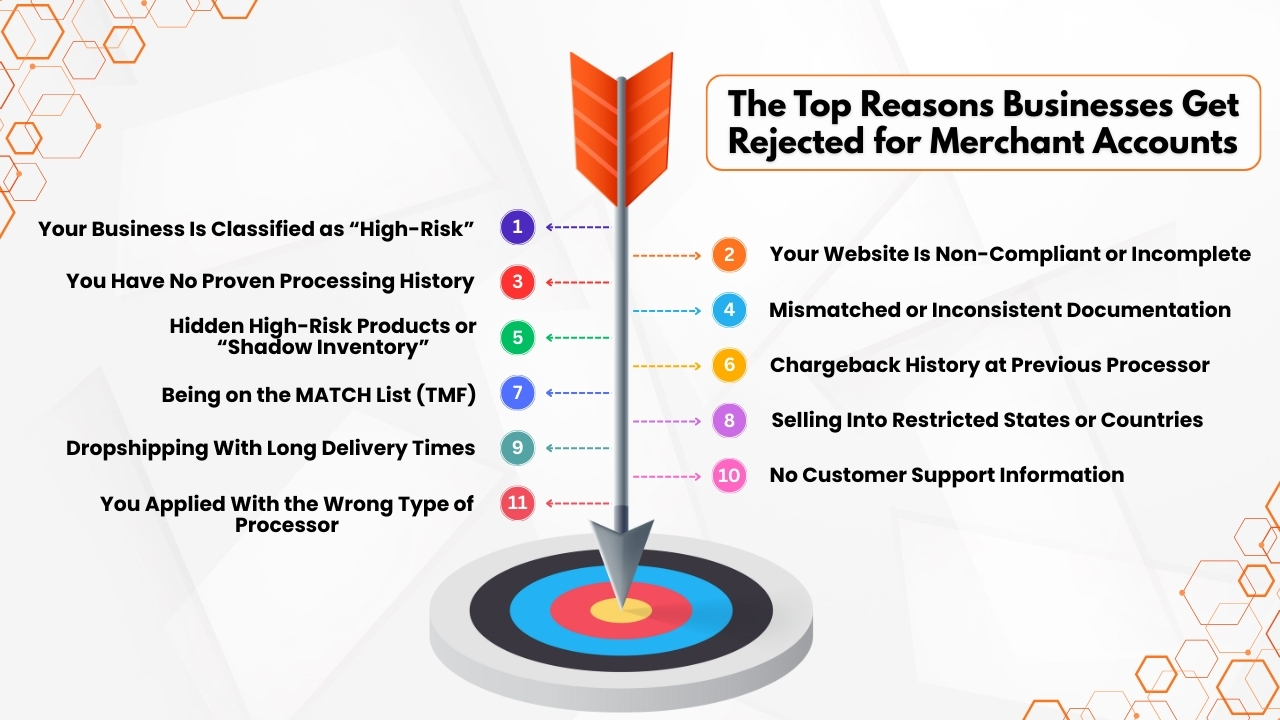
The Top Reasons Businesses Get Rejected for Merchant Accounts
Understanding why merchant accounts get rejected is the first step toward avoiding declines and securing fast approval. Most business owners learn these lessons the hard way and after their application is denied, their funds are frozen, or their processor shuts them down without warning.
But merchant account rejections are almost always predictable. Payment processors follow risk frameworks, compliance checklists, and strict underwriting standards that determine whether a business is safe onboard.
Below are the most common reasons merchant account applications get rejected, explained in detail so you can avoid them altogether.
1. Your Business Is Classified as “High-Risk”
Not all businesses carry the same level of risk. Some businesses are simple like a bookstore, a clothing shop, or a local bakery. Other businesses fall into the high-risk category because they historically experience more chargebacks, tighter regulations, or higher fraud exposure.
Many mainstream processors do not support high-risk industries, meaning your application may be automatically rejected.
Common high-risk industries include:
- CBD, hemp, delta-8, delta-9, vapes
- Nutraceuticals, weight-loss supplements, herbal products
- Coaching, consulting, masterminds, info products
- Subscription billing businesses
- Dropshipping, especially overseas fulfillment
- Travel, ticketing, events, tours
- Digital collectibles, gaming platforms
- MLM, biz-op opportunities
- Custom or made-to-order products
If your industry appears on this list and you apply with a low-risk processor, rejection is almost guaranteed no matter how legitimate your business is.
Fix
Apply with a true high-risk merchant account provider that specializes in your industry and actually supports your business model.
Also Read: Top 5 Features Every Retailers Should Look into Modern Payment Terminal
2. Your Website Is Non-Compliant or Incomplete
This is one of the most common reasons merchant accounts are denied. Underwriters treat your website like your storefront. If anything looks unprofessional, unclear, or risky, they assume your business will create customer disputes and therefore risk them.
Your site must include:
- A visible refund policy
- A clear privacy policy
- Terms & conditions
- A working customer support phone number
- A physical business address
- SSL-secured checkout(https)
- Accurate product descriptions and pricing
- Clear delivery timelines
- No misleading or exaggerated claims
Even small issues like broken links, missing footer pages, or unclear claims can cause a decline.
Fix
Before applying, update your site to meet every merchant compliance standard. A clean, clear, and transparent website significantly increases your chances of getting approved.
Also Read: How to Choose the Right POS System for Your Business
3. You Have No Proven Processing History
Processors prefer merchants who can show a history of responsible payment behavior. If your business is new or lacks transaction history, then it is riskier in their eyes and not because you are doing anything wrong, but because there is no track record to judge.
New businesses get rejected more often when:
- Their average ticket price is high(over $200)
- They sell subscriptions or trial offers
- They ship internationally
- Their industry is already high-risk
- Delivery times exceed 7 days
Underwriters worry that you may not fulfill orders properly or that customers may dispute initial transactions.
Fix
- Start with a modest initial monthly processing limit
- Build volume gradually
- Use a processor that specializes in supporting new or high-risk merchants
4. Mismatched or Inconsistent Documentation
This is one of the fastest ways to get your merchant account application rejected. Even if your business looks strong on paper, underwriters will stop everything the moment your documentation does not line up. Their job is to verify that your business is real, stable, and exactly what you claim it is so they carefully cross-check every detail.
They compare information across:
- Your merchant account application
- Your bank statements
- Your government-issued ID
- Your articles of incorporation or EIN letter
- Your listed business address
- Your website and domain details
Common mismatches that cause an instant decline include:
- The name on your bank account does not match the business name on your application.
- A business address on file that does not match your ID or corporate paperwork.
- Your website or brand name is different from your legal business name.
- Outdated LLC or EIN documents that no longer reflect the current entity.
- Different business categories or descriptions used in different places.
To underwriters, these inconsistencies suggest potential fraud, identity confusion, or operational instability.
Fix
Before you apply, carefully review every document and field, Make sure names, addresses, entity types, and categories match exactly everywhere. Even a small mismatch can be enough to get your application declined.
5. Hidden High-Risk Products or “Shadow Inventory”
Trying to look low-risk while secretly selling high-risk goods is a fast path to denial or worse, termination. Underwriters don’t just read your homepage; they crawl sitemaps, indexed archives, orphaned URL, Wayback snapshots, social profiles, newsletters, invoices, and your full checkout flows.
If they identify undisclosed items like CBD, THC, vapes, gray-market media, they will assume deception and reject the application, sometimes adding you to internal watchlists.
Fix
Be transparent. Apply with a processor that explicitly supports your real catalog. Before applying, audit your domain: inventory every product URL, remove discontinued pages or clearly disclose them, align SKU names and categories, and update robots or sitemaps responsibly(not to hide, but to reflect reality).Document KYC on suppliers and shipping rules by state.
Also Read: Restaurant Credit Card Processing
6. Chargeback History at Previous Processor
Chargebacks are one of the biggest risks for payment companies as they predict future losses like refunds, network fines, write-offs, and costly dispute handling.
If your previous processor reported:
- Chargebacks above 1%
- Excessive refunds
- Strong customer complaints
- Delivery delays
- Fraud indicators
Then, your business will be classified as higher risk and either declined during underwriting or priced up. Before applying, lower your dispute rate with practical, provable changes.
Fix
- Improving your support accessibility
- Displaying clear policies
- Using chargeback alerts
- Strengthening order confirmation and tracking
Ensure you send instant order email, realistic ETAs, live tracking, and proof of delivery. Reduce “unauthorized transaction” disputes by using a recognizable billing descriptor, enforcing AVS or CVV, enabling 3-D Secure when appropriate, and setting basic velocity limits. Also document these improvements to show underwriters a durable fix today.
7. Being on the MATCH List (TMF)
The MATCH list also called the Terminated Merchant File is a shared blacklist used by acquirers to flag merchants terminated for serious issues like excessive chargebacks, suspected fraud, or major policy violations.
If you are on MATCH list:
- 95% of processors will decline you
- Stripe, PayPal, and Square will never approve you
- Banks treat you as extremely risky
If you are on MATCH, most providers will decline you, and aggregates like Stripe, PayPal, and Square won’t approve you. Banks consider you as high-risk but processing is still possible with specialized high-risk acquirers.
Fix
Work with a processor that accepts MATCH merchants and helps you rebuild your payment reputation. Be transparent and show a credible remediation plan. Document the root cause of your termination and the concrete controls that you have added like clearer billing descriptors, AVS or CVV enforcement, 3-D Secure where appropriate, velocity limits, fraud scoring, and strong fulfillment like order confirmations, realistic ETAs, tracking, and proof of delivery). Publish plain-language refund, shipping, and cancellation policies, and make support easy to reach.
8. Selling Into Restricted States or Countries
If you sell regulated products like CBD, supplements, alcohol, nicotine, digital services, or high-value electronics then you must comply with regional laws.
If your website allows checkout from states or countries where your product is not legal, then it will lead to automatic decline. Underwriters test your checkout process, often adding items to cart and entering restricted addresses to see whether your system blocks them.
Fix
- Implement geo-restricted shipping to block prohibited destinations automatically.
- Enforce SKU-level restrictions so banned products never appear or ship to restricted states.
- Automate state-rule checks at checkout with live compliance logic.
- Record decisions for audits and customer support.
- Display compliance warnings to both staff and customers to identify mistakes early, reduce manual errors, and reduce chargebacks.
This prevents legal exposure and dramatically improves approval odds.
9. Dropshipping With Long Delivery Times
Dropshipping itself is not always high-risk but overseas suppliers often cause long shipping times and inconsistent quality. Customers who wait 20-40 days for a product often lose patience and file chargebacks.
Underwriters know this, so they treat dropshipping with caution.
If you cannot guarantee
- Fast fulfillment
- Clear delivery timelines
- Reliable suppliers
Then your merchant account application may be declined.
Fix
- Use United States based or faster suppliers
- Publish realistic delivery estimates
- Keep inventory or partial stock when possible
10. No Customer Support Information
A merchant account is essentially a financial partnership. Processors assume that if customers cannot reach you, they will instead dispute the charge with their bank which costs the processor money.
If your website has:
- No phone number
- No email address
- No support chat
- No support page
- Slow response times
It indicates a high risk of chargebacks.
Fix
Make support obvious and accessible like publishing phone, email, chat, and working hours. Respond quickly with tracked SLAs. Accessible, responsive support reassures underwriters, reduces disputes, refunds, and chargebacks, and makes onboarding smoother.
11. You Applied With the Wrong Type of Processor
Stripe, PayPal, and Square are payment aggregators and not individual merchant accounts. They are optimized for low-risk sellers and fast onboarding, which also means automated risk controls that can cause sudden freezes if your category, dispute rate, or sales spikes look risky.
For CBD, supplements, digital products, coaching, travel, dropshipping, subscriptions, or volatile items, that often means held funds, paused payouts, or outright account closures and bans.
Fix
Get a dedicated merchant account with full underwriting matched to your true business model. You will receive a proper MCC, clearer expectations, and risk terms suited to your catalog for instance rolling reserve, volume limits, or ticket limits to start. Rather offer compliant websites, matching documentation, open product disclosures, COAs or licenses where required, and clear refund or shipping policies.
Add fraud tools like AVS or CVV, 3DS, velocity rules and dispute prevention through alerts, recognizable descriptors.
How to Get “Instant Approval” (What It Really Means)
“Instant approval” is a marketing promise of speed and not a shortcut that skips underwriting. It means you are quickly onboarded to start taking payments while the processor continues risk checks like KYC or KYB, website review, transaction monitoring simultaneously. Even after you start processing, providers can still impose limits, reserves, or holds so don’t try to avoid scrutiny; make passing it straightforward.
What qualifies you for true fast-track approval
1. Clear product pages
Make product pages concrete and credible like use real photos, plain-language descriptions, and remove all placeholder or “coming soon” listings. And if your category requires proof like age gates, Certificates of Analysis, license, or safety labels then display them on the page. Clarity and evidence reduce underwriting friction, disputes, and surprises for both processors and customers.
2. Matching documentation
Submit a complete, consistent document pack like government ID, EIN or LLC registration, bank letter or voided cheque, proof of address, the last three months of bank statements, and any prior processing statements.Ensure business name, owner name, and address match exactly across every file to avoid delays, reviews, declines, and compliance holds.
3. Low initial volume and ticket size
Begin with conservative processing limits on monthly volume and average ticket, then propose a phased increase connected to evidence like on-time fulfillment, low refund and chargeback rates, stable deposits, and audited controls. This reduces perceived exposure for underwriters,accelerates initial approval, and places you for predictable limit, pricing, and settlement improvements.
4. No high-risk claims
Avoid high-risk claims from your site like no guarantees, miracle cures, that quietly auto-renew. Use clear, evidence-based language and disclose all material terms upfront like pricing, renewal cadence, cancellation steps, and shipping timelines. Transparency reduces disputes, reduces regulatory exposure .
5. Proper customer support setup
Build support users can find and trust: publish a phone number, email, and live chat, and display business hours, and reply quickly with tracked SLAs. Add a clear FAQ for common issues and a self-serve portal for subscription changes and cancellations. Visible, responsive care prevents disputes and strengthens underwriting confidence overall.
Rapid Approval Readiness Blueprint
1. Do a pre-apply audit (clean what underwriters will see)
Crawl your domain and subdomains like XML sitemaps, indexed archives, orphan URLs, and historical snapshots. Remove non-compliant pages like placeholders, prohibited items, and exaggerated claims) and fix broken links.
Align legal name, address, phone, and support email everywhere like homepage footer, contact page, policies, invoices. Ensure SSL is active site-wide and checkout runs without errors.
2. Publish plain-language policies (front and center)
Put refunds or returns, shipping windows, subscription cadence, and cancellation steps on product pages, at checkout, and on receipts. Use simple, specific language for instance, “Ships in 2-3 business days”, “Renews monthly on the 15th”). Add an FAQ including delivery timelines, sizing or fit, billing descriptors, and returns. Clear, consistent policies reduce uncertainty and preempt disputes.
3. Harden dispute prevention (prove, inform, confirm)
Use a recognizable statement descriptor. Send instant order confirmations and status updates with realistic ETAs, tracking links, and proof-of-delivery capture.
Activate AVS or CVV, add 3-D Secure where helpful(high tickets, risky geos); and set velocity rules like orders per card or IP or time. These controls reduce “not received”, “not recognized”, and fraud-related chargebacks.
4. Offer comfort terms (de-risk the ramp)
Indicate partnership by accepting modest reserves, category caps, or conservative limits initially. Propose a written step-up plan connected to objective triggers: 90 days of on-time fulfillment, dispute rate <0.8%, stable balances, and no alerts. This converts “unknown risk” into “managed risk,” accelerating approval and unlocking predictable increases in volume, ticket size, and settlement speed.
5. Make hygiene visible (package evidence neatly)
Assemble a single, labeled document pack: government ID, EIN or LLC, bank letter or voided cheque, proof of address, 3 months of bank statements, prior processing statements, licenses or COAs, supplier KYC.
Ensure all names or addresses match exactly. Include screenshots of policies, checkout flow, and descriptor. Organized, consistent evidence shortens underwriting cycles and prevents avoidable follow-ups.
Reality check
“Instant” starts you quickly, but it’s still provisional. Treat the first months like an extended interview: ship on time, keep disputes well below network thresholds, and communicate clearly with customers. Do that, and “instant approval” becomes enduring approval—with better pricing and higher limits over time.
Conclusion
Merchant account rejections rarely happen accidentally. Rather mostly account rejections happen due to predictable issues like non-compliant websites, mismatched documents, unclear policies, unmanaged chargebacks, and risky claims. The solution is just as predictable and makes risk visible, measurable, and controlled.
Begin with a credible storefront like SSL on every page, consistent branding, real product photos, accurate pricing, and plain language policies for refunds, shipping, subscriptions, and cancellations. Align names and addresses across your site, bank letter, government ID, and corporate filings. Then make dispute prevention stronger with recognizable statement descriptors, instant confirmations, realistic ETAs, tracking, proof of delivery, AVS or CVV, 3-D Secure where helpful, and simple velocity rules.
Pick the right model: aggregators onboard fast but reject borderline risk, while fully underwritten merchant accounts take longer to open yet provide lasting stability. Begin with conservative limits, accept reasonable reserves, and present a step-up plan connected to performance metrics like on-time fulfillment, sub-1% disputes, stable balances.
Ultimately, make support unmistakable and responsive with phone, email, chat, posted hours, and a self-serve portal. Keep an organized compliance kit like COAs, licenses, supplier KYC, and audit quarterly.
Do these things well and “instant approval” becomes realistic: rapid onboarding now, steadier cash flow tomorrow, and a processing partner that scales with you. Document results and share dashboards with underwriters to prove sustained, well-managed operational performance over time.
If you still have any query regarding why businesses are getting rejected for Online Merchant accounts and how they can get their account instantly approved then feel free to write to us at Ace Merchant Processing and we are more than happy to assist you.