Merchant processing services are the foundation of modern payment processing. These services help small businesses to accept and manage digital payments easily.
As more and more customers prefer to do cashless payments, hence customers expect that businesses enable multiple payment methods like credit cards, debit cards, mobile wallets, and online payments.
Small businesses cannot consider adopting reliable merchant services as an option. Instead, adopting reliable merchant services has become essential for them to stay competitive and meet changing customer expectations.
Implementing a trusted merchant services provider ensures customers that the businesses are offering secure and seamless transactions. Whether payment gateways for eCommerce, advanced POS systems for in-store purchases, these merchant processing services help businesses for processing payments quickly and accurately.
Each transaction has payment processors, card networks, and banks work together behind the scenes in order to authorize and complete payments within seconds that gives a smooth checkout experience for customers.
Choosing the right merchant processing solution can improve business performance. Because effective payment processing systems help to increase sales, reduce cart abandonment, and improve cash flow through quick settlements.
These systems help to improve the customer experience by offering flexible and convenient payment options.
Additionally, modern merchant services include features like fraud protection, data security, and real-time analytics which helps businesses to make smarter decisions and operate efficiently.
For small businesses, understanding merchant processing services is essential for their long-term success. It is essential for small businesses to evaluate different factors such as transaction fees, processing speed, security compliance, and scalability.
When businesses select the right payment solutions, businesses can enable seamless operations, build customer trust, and build a strong foundation for sustainable growth in today’s competitive digital market.
Also Read: What are Merchant Services and How do They Work for Businesses
What Are Merchant Processing Services?
Merchant processing services help businesses to accept electronic payments from customers quickly, securely, and efficiently. These services work as the bridge between the customer’s bank and the business’s bank account that enables businesses to complete card and digital payments without any delays.
In today’s business environment, merchant processing is essential for companies that want to offer flexible and convenient payment options.
Whenever a customer swipes, taps, inserts, or enters card details online, a process begins behind the scenes. The payment information of customer data is then securely transmitted, verified, authorized, so that the funds can transfer the funds from customer’s account to the merchant’s account.
Merchant processing services ensure that the system works smoothly that helps businesses to smooth checkout experience while maintaining payment security.
In simple terms, merchant processing helps businesses:
- Accept credit and debit card payments both in-store and online.
- Process mobile payments through smartphones, tablets, or payment apps.
- Handle contactless transactions such as tap-to-pay and digital wallets.
- Transfer funds securely into the business bank account after settlement.
- Improve customer convenience by offering more than just cash payments.
Without merchant processing services, businesses would have been accepting just cash-only transactions which can reduce sales opportunities, inconvenience customers, and also slow down long-term business growth.
Also Read: What is Payment Processing Software
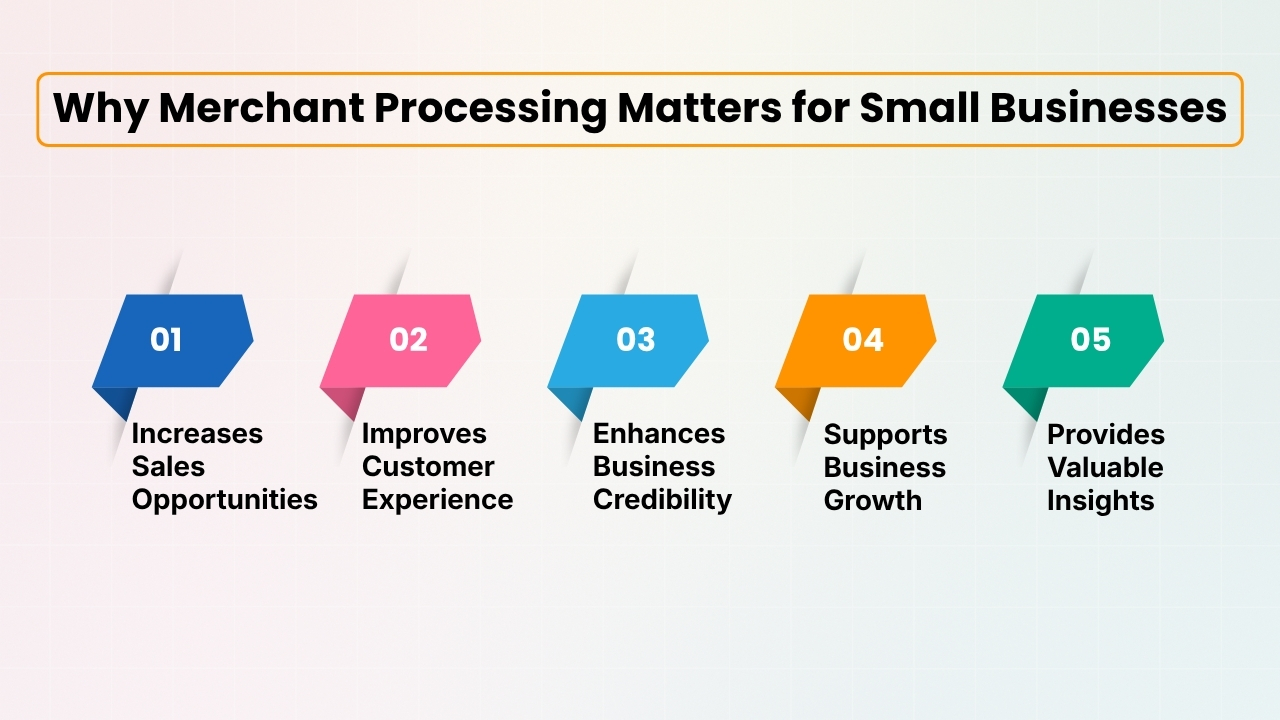
Why Merchant Processing Matters for Small Businesses
Small businesses function in a highly competitive environment where every customer experience, speed, and convenience can play a crucial role for winning and keeping customers.
Merchant processing services play an important role in shaping the way customers interact with your business from the moment customers decide to purchase to the final checkout experience.
When small businesses implement a reliable payment system, it not just improves efficiency but also helps businesses to build trust, increase profits, and grow effectively.
1. Increases Sales Opportunities
Customers expect businesses to accept multiple payment options. Because when a business offers credit cards, debit cards, mobile wallets, contactless payments, and online payment options, it becomes easier for customers to complete their purchases as per their convenience.
When these businesses offer flexibility in payments helps businesses to reduce checkout challenges and helps prevent abandoned sales. As a result, these services help businesses to attract more customers, improve conversion rates, and increase total revenue.
Also Read: How to Build Payment Processing With Ace Merchant Processing
2. Improves Customer Experience
A smooth efficient checkout process is essential for giving a positive experience to customers. Because if the customers have to wait long, or if there are payment errors, or limited payment options may frustrate customers and affect brand image of the businesses.
Merchant processing systems deliver quick approvals and reliable performance to make transactions faster and easier. Such convenience leaves customers satisfied and encourages them to return back.
Also Read: Small Business Inventory Tracking
3. Enhances Business Credibility
Modern payment systems help small businesses to appear more professional and trustworthy. Then customers feel confident to buy from businesses that offer secure and familiar payment options.
Many features such as encrypted transactions, fraud protection, and secure terminal helps to build customer trust and ensures that the businesses take the security of customer data rigorously.
Also Read: Why Business Get Rejected for Online Merchant Account
4. Supports Business Growth
As business grows, even their payment requirements become more advanced. Merchant processing solutions can expand with the business as it supports larger transaction volumes, online payments, recurring billing, and even multiple store locations.
Offering flexible payment options helps businesses to grow without requiring to replace their existing entire payment system.
Also Read: How to Manage Small Business Efficiently Using Modern Payment Systems
5. Provides Valuable Insights
Many merchant processing platforms have reporting and analytics features. These tools help businesses to track sales patterns, customer behavior, and busy transaction times.
With such insights, businesses can make smarter decisions, improve operations, and plan effectively for future growth.
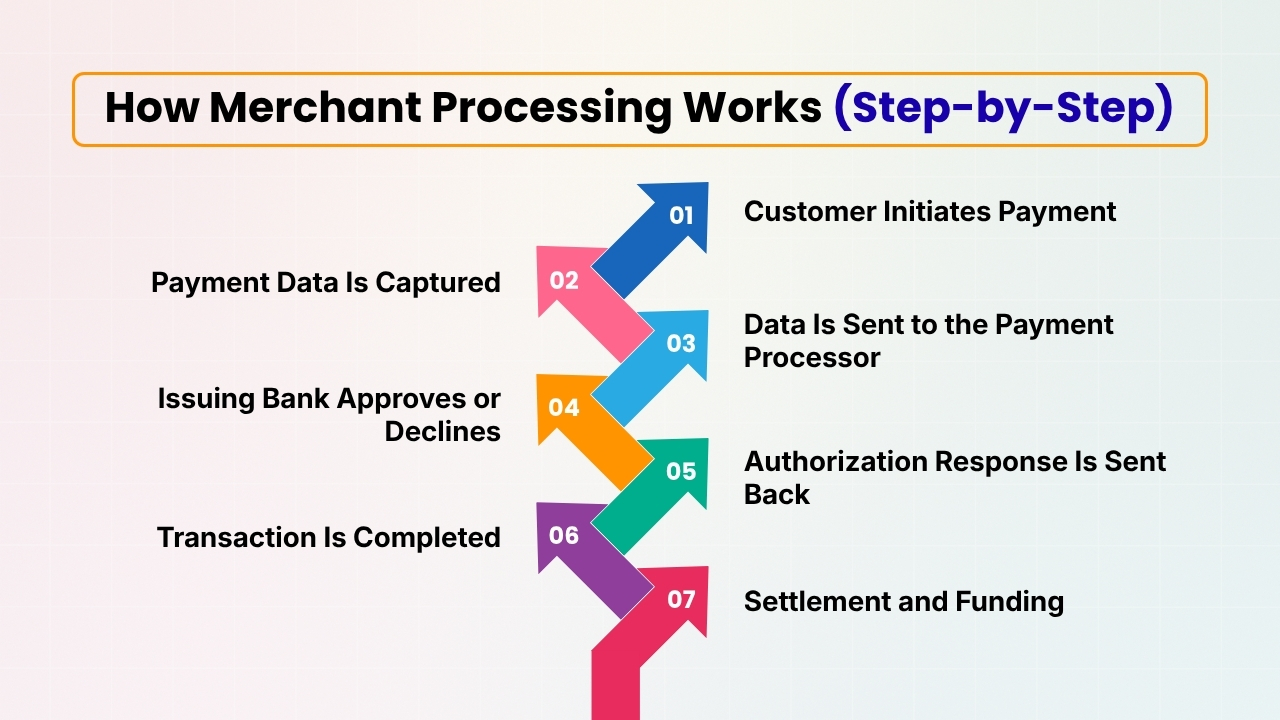
How Merchant Processing Works (Step-by-Step)
Understanding how merchant processing works is essential for small businesses that want to offer a smooth, secure, and reliable payment experience.
While the process may seem simple, several systems work together behind the scenes to ensure that every transaction is completed accurately and quickly.
From the time a customer initiates a payment to the final settlement of funds, each step plays a crucial role in ensuring efficiency and security.
1. Customer Initiates Payment
The process starts with customers willing to make a payment using their preferred payment option. Their preferred payment method could be a credit card, debit card, mobile wallet, or an online payment option.
When customers are shopping in a physical store, then the customer may consider tapping, swiping, or inserting their card into a POS terminal. For online purchases customers usually enter their card details or select a digital wallet at checkout. The entire merchant processing workflow starts with this step and then puts the transaction into action.
Also Read: Top Retail Payment Trends Every Business Should Know
2. Payment Data Is Captured
Once the payment is initiated, the system then captures the transaction details. These details are captured through a POS system, card reader, or payment gateways based on the type of transaction the customer uses.
The captured data could be card information, transaction amount, merchant details, and time of purchase. Modern systems encrypt the data instantly to protect sensitive customer data from fraud or unauthorized access.
3. Data Is Sent to the Payment Processor
After capturing the payment details, the information is then securely transmitted to the payment process. The processor then acts as the bridge which communicates between the merchant, card networks, and banks.
It then forwards the transaction request to the accurate card network such as Visa, Mastercard, or American Express. This step happens in seconds and then ensures that the transaction moves ahead for authorization.
Also Read: How to Choose the Right POS System for Your Business
4. Issuing Bank Approves or Declines
The card network then sends the transaction details to the customer’s issuing bank. At this phase, the bank verifies several factors that include available funds, card validity, and potential fraud risks.
If everything checks out, the bank approves the transaction. If there are insufficient funds, incorrect details, or suspicious activity, the transaction may be declined. This step is crucial for maintaining payment security and avoiding fraudulent transactions.
Also Read: Restaurant Credit Card Processing
5. Authorization Response Is Sent Back
Once the issuing bank decides, then the bank sends the authorization response through the same channel from the bank to the card network, then to the payment processor, and ultimately to the merchant’s system.
The response of the bank indicates whether the transaction was approved or declined. The entire process happens instantly that lets customers receive instant feedback during checkout.
6. Transaction Is Completed
In this step the transaction is approved, the payment is completed, and then the customer receives confirmation. If there is a retail setting, the customers may receive a printed or digital receipt.
If there are online transactions, a confirmation message or email is generated. At this step the funds are not yet transferred to the merchant’s account but the transaction has been successfully authorized. This step ensures that the purchase is finalized from the customer’s perspective.
7. Settlement and Funding
The last step of merchant processing is settlement and funding. At the end of each business day, the merchant then sends all approved transactions in a batch to the payment processor.
Then the processors coordinate with the card networks and issuing banks to transfer the funds. The money is then deposited into the merchant’s account within 1-3 business days based on the provider and agreement.
These steps ensure that businesses receive their payments securely and can manage their cash flow effectively.
Understanding how merchant processing works helps small businesses to better choose the right provider, troubleshoot concerns, and optimize their checkout experience for improved customer satisfaction and business growth.
Also Read: What Payment Methods Should Retailer Accepts
Key Components of Merchant Processing
Merchant processing is not done by a single system rather by a combination of several components working together to ensure that the payments are smooth, secure, and efficient.
Understanding each component helps small businesses to build the right payment systems and choose the system that fits their operational requirements.
1. Merchant Account
A merchant account is a specialized type of bank account which allows businesses to accept card payments from customers. Unlike a regular business account, a merchant account holds funds on a temporary basis before transferring them to the main business bank account.
This process ensures that payments are verified before the settlement. It is essential to have a reliable merchant account for managing cash flow and maintaining secure payment operations.
2. Payment Processor
The payment processor works as the crucial link in the transaction process. This processor communicated between the merchant, card networks, and banks for authorizing and completing payments.
The processor ensures that the transaction data is transmitted securely and processed in real time. This handles tasks such as fraud checks, transaction routing, and settlement coordination making it an important component of merchant processing.
3. Payment Gateway
A payment gateway is utilized for online payments and eCommerce transactions. This gateway captures customer payment details, encrypts sensitive customer data, and sends it securely to the payment processor.
This gateway acts as a digital connection between the customer and the business that ensures safe and seamless online transactions. Without having a payment gateway, businesses cannot securely accept payments through websites or mobile apps.
4. POS System (Point of Sale)
A POS system is utilized for in-store transactions which combines both hardware and software to process payments and also manage sales. It includes devices such as card readers, terminals, or tablets, along with software or billing, inventory management, and reporting.
A modern POS system not just handles payments rather also improves operational efficiency by tracking sales and customer data.
Also Read: Retail Payment Methods Transforming the Market
5. Card Networks
Card networks such as Visa, Mastercard, and American Express play an important role in merchant processing. It acts as intermediaries which facilitate communication between the issuing bank and the acquiring bank.
Card networks set transaction rules, ensure security standards, and enable the smooth flow of payment data across the system.
6. Issuing Bank
The issuing bank also known as the customer’s bank is the bank that provides the credit or debit card to the customer. When a customer initiates a transaction, then the issuing bank verifies the payment by checking their available funds, card validity, and fraud risks.
Then the issuing bank either approves or declines the transaction. This step is crucial as it ensures that the payments are valid and secure.
7. Acquiring Bank
The acquiring bank is also known as the merchant’s bank. This bank receives the funds from the transaction. This bank works with the payment processor to ensure that approved payments are settled and deposited into the merchant account.
The acquiring bank plays a crucial role in managing merchant accounts and then facilitates the final transfer of funds. All these components form a complete merchant processing ecosystem.
Each component has a specific role, and their seamless coordination ensures that businesses can accept payments effectively, offering customers a fast and secure checkout experience.
Types of Merchant Processing Services
Different businesses have different operational models, customer preferences, and sales channels. As a result, merchant processing services come in different forms to meet these different requirements.
Whether you run a retail store, an online business, or a service-based company, choosing the right type of payment processing solution is essential for delivering a smooth and efficient customer experience.
1. In-Store Payment Processing
In-store payment processing works well for businesses that operate from physical locations such as retail stores, restaurants, and service centers. This type of processing includes card machines, POS systems, and contactless payment devices which allow customers to pay instantly with their cards or mobile wallets.
These systems are essential for managing sales, inventory, and customer data that makes daily operations more efficient.
2. Online Payment Processing
Online payment processing allows businesses to accept payments through websites, eCommerce stores, and mobile apps. This type of processing services use secure payment gateways for processing transactions safely.
It supports cards, digital wallets, and other online payment methods which helps businesses to offer a smooth checkout experience and reach more customers.
3. Mobile Payment Processing
Mobile payment processing is essential for businesses like delivery services, freelancers. With mobile card readers and mobile based tools helps businesses to accept payments from anywhere.
Such type of processing enhances flexibility in payments for customers, convenience, and transaction speed for both businesses and customers.
4. Virtual Terminals
A virtual terminal is a secure web-based tool which allows businesses to process payments manually without using physical card machines. This type of processing is used mostly for phone orders, mail orders, and remote transactions.
In such processing staff just have to enter customer payment details directly into the system to complete the sale. Such terminals are useful for service-based businesses, consultants, and B2B companies.
Also Read: Top 5 Features Every Retailer Should Look into Modern Payment Terminal
Key Features to Look for in Merchant Processing Services
1. Fast Transaction Speed
For running business operations smoothly it is essential to have a fast transaction speed. A reliable payment processing system must handle transactions instantly to reduce customer wait times and enhance customer satisfaction even during busy hours.
2. Multiple Payment Options
Customers expect multiple payment options while making payments. Choosing a system that supports credit cards, debit cards, contactless payments, mobile wallets, and online payments ensures that the businesses never miss a sale.
3. Security and Compliance
While processing payments, security is a top requirement for customers. Ensure you look for providers that offer PCI compliance, data encryption, and fraud protection tools that keep customer data safe and also reduce risks.
4. Transparent Pricing
Avoid hidden fees by choosing a provider that has clear pricing. It is essential to understand transaction fees, monthly costs, and additional charges which helps to manage expenses effectively.
5. Integration and Reporting
A good merchant processing system must easily integrate with your POS, accounting, and inventory software. It should also offer detailed reports and analytics which helps you to track sales, performance, and make informed decisions.
Common Pricing Structures
1. Flat-Rate Pricing
Flat-rate pricing is one of the simplest and transparent models for small businesses. In this type of pricing, you pay a fixed percentage per transaction irrespective of the card type or issuing bank.
Flat-rate pricing is easy to understand as it helps with predictable budgeting that makes it an excellent choice for startups and businesses with lower transaction volumes.
2. Tiered Pricing
Tiered pricing groups transactions into qualified, mid-qualified, and non-qualified. Where each category has a different rate based on factors like card type and risk level.
Though this pricing model may seem attractive initially, this pricing model can be less transparent because it is not clear how transactions are categorized.
3. Interchange-Plus Pricing
Interchange-plus pricing is the most transparent and cost-effective option for many growing businesses. Because it separates the base interchange fee set by card networks from the processor’s markup.
Businesses pay the actual interchange rate and a fixed markup which offers better clarity and lower costs as transaction volumes increase.
Benefits of Merchant Processing for Small Businesses
Merchant processing services offer a strong foundation for small businesses to function efficiently, serve customers better, and grow sustainably.
By enabling modern payment processing helps businesses to streamline operations while improving financial performance and customer satisfaction.
1. Increased Revenue
Small businesses offer multiple payment methods such as credit cards, debit cards, mobile wallets, and online payments allow customers to complete their purchases easily.
When customers are provided with multiple payment options, then there are high chances that customers will buy that lead to higher conversion rates and increased overall revenue.
2. Improved Efficiency
Automated merchant processing systems reduce the requirement for manually calculating which reduces human errors. When transactions are completed instantly and accurately, it saves time for both staff and customers.
This efficiency helps businesses to handle more transactions in less time even during busy hours.
3. Better Cash Flow
Enabling faster payment processing and settlement ensures that funds are transferred to the business account within less time. It improves cash flow management that allows businesses to cover expenses, manage inventory, and plan for growth effectively.
4. Enhanced Security
Modern merchant processing solutions have advanced security features such as encryption, tokenization, and fraud detection. These features secure sensitive customer data that reduces the risk of fraud or chargebacks that builds trust and reliability.
5. Scalability
Merchant processing systems are designed to grow with your business. When businesses expand to new locations, add online sales, or increase transaction volume, these solutions grow accordingly.
This flexibility of different payment options ensures that your payment system continues to support your business as it changes.
Conclusion
Merchant processing services for small businesses are no longer just a convenience rather a necessity in today’s quickly changing and highly competitive market.
While customer expectations continuously change, businesses must offer fast, secure, and flexible payment options which helps them to stay valid and competitive.
A reliable merchant processing system not just simplifies transactions but also improves the overall customer experience which helps businesses to build customer trust and loyalty.
From increasing sales opportunities, improving operational efficiency, the right payment solution plays a crucial role in ensuring everyday business success.
This allows businesses to accept multiple payment methods, reduce checkout friction, and ensure secure handling of customer data.
Additionally, features such as reporting and analytics offer valuable insights which support smarter decisions and long-term growth strategies.
Choosing the right merchant processing provider requires careful evaluation of features, pricing, scalability, and customer support.
Selecting a solution which aligns with your business requirements, you can create a seamless payment experience which is beneficial for your customers and your operations.
In the long run, investing in a dependable merchant processing service helps small businesses to adapt to changing market patterns, improve financial management, and grow confidently.
It is not just about processing payments rather it is about building a stronger, efficient, and future-ready business.
If you still have any query with merchant processing services for small businesses then you may book a free demo at Ace Merchant Solutions then we are more than happy to assist you.