In today’s competitive digital marketplace, businesses depend on secure and efficient payment processing systems which helps them to manage online transactions and customer convenience.
Still many high risk businesses usually face difficulties for getting a merchant account approval from traditional payment processors and banks.
Because these businesses have high exposure to fraud, high chargeback rates, recurring billing models, or strict regulatory requirements are often classified as high-risk businesses.
Such businesses need specialized high-risk merchant accounts which helps to process their payment safely and maintain business operations without any operations.
A high-risk merchant account is a specialized payment processing service customized for industries that banks and financial institutions classify as having high financial, regulatory, or operational risk.
Businesses that are involved in online gambling, CBD products, adult entertainment, travel services, cryptocurrency trading, forex businesses, nutraceuticals, subscription-based services, and certain e-commerce businesses often face difficulties obtaining approval from standard merchant service providers.
Traditional banks and payment processors often are reluctant to work with high risk businesses as there are problems due to fraud prevention, legal compliance, chargebacks, and financial liability.
To overcome such challenges, high-risk businesses often rely on specialized high-risk payment processors and high-risk payment gateways that offer them secure transaction processing, chargeback management, fraud detection tools, recurring billing support, and multi-currency payment capabilities.
Though high-risk merchant accounts may have higher transaction fees, rolling reserves, and stricter underwriting processes but it offers them the stability and security essential for long-term growth.
As online commerce is continuously expanding globally, the demand for reliable merchant services for high-risk businesses is increasing rapidly.
Selecting the right payment processing solution can help businesses to reduce chargebacks, improve transaction approval rates, improve customer trust, and ensure financial stability.
This blog will walk you through the major industries that require high-risk merchant accounts, the reasons why some businesses are classified as high-risk, and the benefits of using secure high-risk payment processing solutions in today’s quickly changing digital economy.
Also Read: High-Risk Merchant Account Instant Approval
What Is a High-Risk Merchant Account?
A high-risk merchant account is a specialized payment processing account that is created for businesses that have high risks of fraud, chargebacks, regulatory challenges, and financial uncertainty.
Before approving merchant services payment processors and banks verify businesses based on industry type, transaction volume, customer behavior, recurring billing models, and compliance requirements.
Businesses operating in certain industries like online gaming, CBD, travel, adult entertainment, cryptocurrency, and subscription services are often classified as high-risk industries.
As traditional payment processors may reject high risk businesses, they require a provider that specializes in high-risk payment processing solutions.
Also Read: Why Businesses Get Rejected for Online Merchant Accounts
Key Features of High-Risk Merchant Accounts
These merchant accounts help businesses:
- Accept debit and credit card payments securely
- Process online and international transactions
- Manage recurring billing and subscription payments
- Reduce fraud risks with advanced security tools
- Handle chargebacks and payment disputes effectively
- Support multi-currency payment processing
High-risk merchant accounts are crucial for such businesses because they operate in industries which have high financial risks and regulatory challenges.
Irrespective of high fees and stricter merchant approval requirements, these merchant accounts offer secure and dependable payment processing which helps businesses to operate smoothly and achieve sustainable growth in competitive digital markets.
Also Read: Merchant Account Approval Process
Why Businesses Are Classified as High-Risk
Many business owners assume that if their businesses are classified as “high-risk” then it means that their business is illegal or not reliable, while this is not true.
Many well known and successful companies are categorized as high risk due to higher chargeback rates, higher fraud exposure, recurring billing, and strict industry regulations.
Banks and payment processors first verify the risks of fraud, chargebacks, financial instability, and legal complications before they approve merchant accounts.
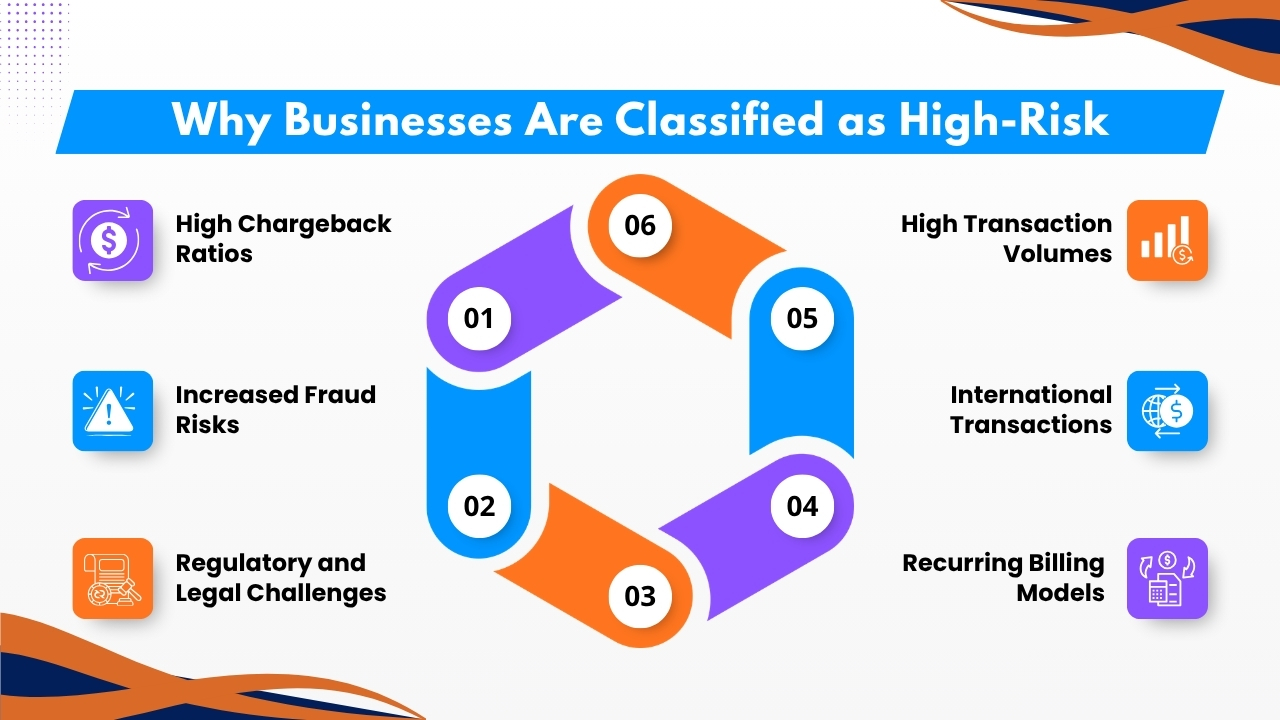
Below are the reasons businesses are classified as high-risk merchants.
1. High Chargeback Ratios
Chargebacks happen when customers dispute transactions through their banks or credit card providers. As businesses with high chargebacks have high risk as they often create financial losses for payment processors.
Industries that use subscription billing, delayed delivery services, or digital products usually experience higher dispute rates. Common instances include online coaching platforms, travel agencies, membership websites, and streaming services.
If a business goes beyond a chargeback ratio of more than 1% then payment processors may issue warnings, impose penalties, or terminate the merchant account.
Also Read: Merchant Processing Services Explained for Small Businesses
2. Increased Fraud Risks
Businesses that process payments online or card-not-present transactions usually have high risks of fraud. As fraudsters often use stolen credit cards, fake identities, or unauthorized payment details to make fraud purchases.
Industries like e-commerce, cryptocurrency exchanges, online gaming, and digital product sales have high risks of fraud. Because of high fraud-related losses, payment processors often classify these businesses as high risk and require to take advanced fraud prevention measures.
Also Read: What Payment Methods Should Retailer Accept
3. Regulatory and Legal Challenges
Certain industries operate under strict or constantly changing regulations. Like businesses involved in CBD products, online gambling, cryptocurrency, telemedicine, often face legal complexities because laws for such businesses differ across countries and states.
Payment processors may classify these businesses as high-risk to avoid compliance issues and reduce legal liability associated with changing government regulations.
Also Read: Instant Approval Online Merchant Account
4. Recurring Billing Models
Subscription-based businesses are often classified as high-risk because recurring payment can often cause customer disputes. There are chances customers may forget about subscriptions, misunderstand billing terms, or request chargebacks for automatics renewals.
SaaS platforms, streaming services, membership websites, and subscription box companies commonly face these issues, making them more likely to require high-risk payment processing solutions.
5. International Transactions
Businesses that operate worldwide usually process cross-border transactions which increases the risk of fraud and payment disputes. There can be concerns like currency conversions issues, international regulations, and overseas fraud risk that makes payment processing more complex.
As a result, businesses that are handling international payments require high-risk merchant accounts with multi-currency support and fraud monitoring tools.
6. High Transaction Volumes
Businesses that process high-value transactions often create higher financial risks for payment processors. Industries like luxury travel, investment services, and premium coaching programs usually handle expensive purchases.
If any dispute or fraud happens, the financial losses will be high due to which payment processors classify such businesses as high-risk merchants.
Also Read: Merchant Account Services Complete Guide for Businesses
Industries That Need High-Risk Merchant Accounts
Certain industries consistently require high-risk merchant accounts because of high risk of fraud, high chargeback rates, or regulatory challenges.
Such businesses often face difficulty to get approval from traditional banks and payment processors.
As a result, high-risk businesses rely on specialized high-risk payment processing solutions to maintain steady payments and business continuity.
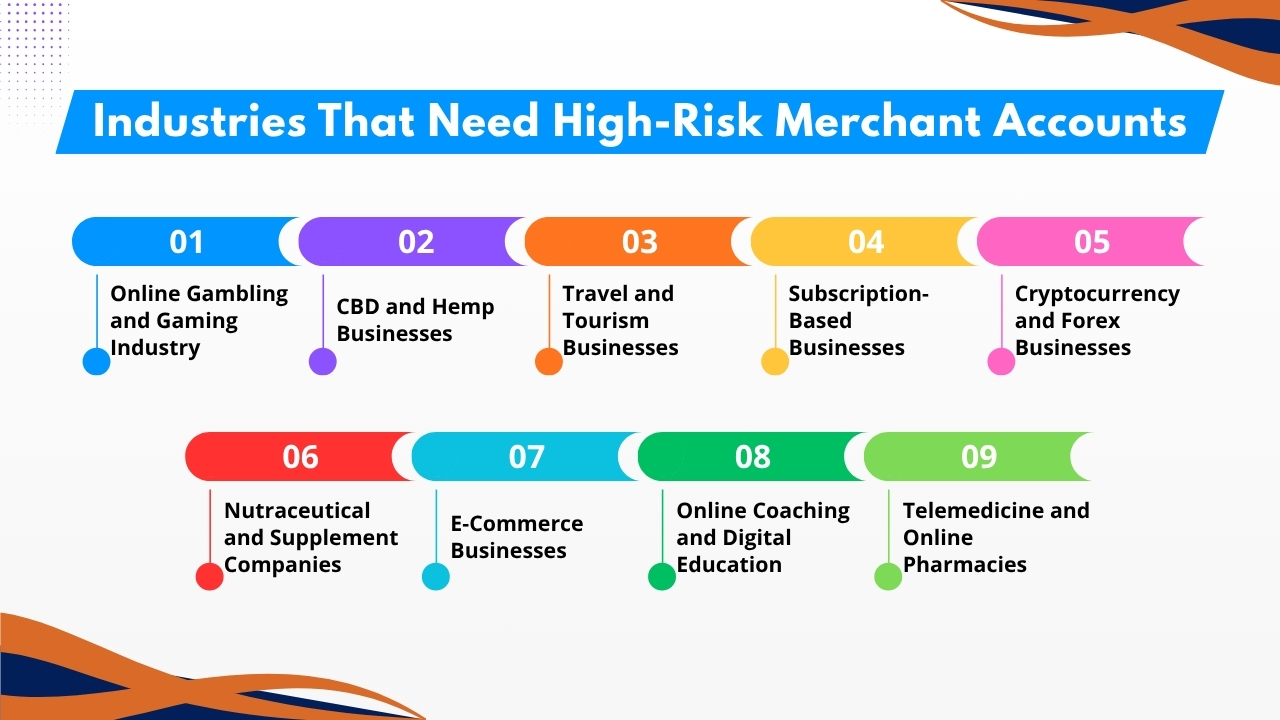
Industries like online gambling, CBD businesses, travel services, cryptocurrency trading, subscription-based platforms, nutraceuticals, and high-volume e-commerce usually come under high-risk categories.
These businesses often depend on secure payment gateways to manage risks and to ensure payment processing without any interruptions.
1. Online Gambling and Gaming Industry
The online gambling and gaming industry is one of the well known examples of a high risk sector in the payment processing sector. As the online gaming and gambling industry operates in a highly regulated environment, most businesses in this category require high-risk merchant accounts to process payments securely and reliably.
Online gambling and gaming industries require a lot of platforms like online casinos, sports betting websites, poker rooms, fantasy sports platforms, and skill-based gaming applications.
Each of these business models involves real-money transactions that increases both financial and regulatory risk for payment processors.
Why Gambling Businesses Are High-Risk
There are several important factors due to which online gambling and gaming are classified as high-risk because:
- Strict government regulations across different countries and regions
- Complex cross-border legal requirements
- Increased risk of fraud transactions
- Concerns due to money laundering activities
- Higher-than-average chargeback ratios due to customer disputes
Because of all these challenges, many traditional banks and payment processors completely avoid working with online gambling or gaming businesses.
Why High-Risk Merchant Accounts Are Necessary
For operating smoothly, gambling businesses depend on specialized high-risk payment processing solutions which provide:
- Anti-Money Laundering (AML) compliance support
- Advanced fraud detection and monitoring systems
- Secure and scalable payment gateway integration
- Multi-currency transaction processing capabilities
- Reliable international payment support
Online gambling and gaming operators without having access to high-risk merchant accounts often face difficulties in processing payments, to manage compliance requirements, and maintain global operations.
Also Read: Smart Payment Solution for Gaming and Esports
2. CBD and Hemp Businesses
The CBD and hemp industry has high growth due to increase in consumer demand for wellness, natural remedies.
Despite its popularity, payment processing is a major challenge for CBD merchants because of ongoing regulatory uncertainty and changing legal laws across different regions.
As a result, most CBD businesses require high-risk merchant accounts to process their transactions smoothly and avoid any interruptions.
Even in countries or states where CBD products are legally allowed, still many banks, financial institutions and traditional payment processors still remain cautious about associating with CBD businesses.
This hesitation is mainly because of compliance risks, inconsistent regulations, and concerns about product classification often cause account restrictions or sudden account terminations.
Challenges Faced by CBD Businesses
CBD merchants commonly deal with several operational challenges, including:
- Regulatory inconsistencies across different states
- Product compliance and labeling concerns
- Strict advertising and marketing restrictions
- Higher-than-average refund and chargeback rates
- Cross-border shipping and legal barriers
Because of these concerns, standard payment processors often freeze funds or shut down CBD merchant accounts without prior notice.
Benefits of High-Risk Payment Processing
To overcome such challenges, CBD businesses depend on specialized high-risk payment processors that provide:
- Industry-compliant merchant account solutions
- Advanced chargeback prevention and monitoring tools
- Secure and seamless e-commerce payment integration
- Flexible banking partnerships that support CBD transactions
Such high-risk payment solutions help CBD and hemp businesses to maintain stable operations, reduce payment interruptions, and expand confidently in a highly regulated and competitive global market.
Also Read: Hospitality Merchant Services for Hotels and Resorts
3. Travel and Tourism Businesses
Travel and tourism businesses are considered one of the most common high-risk industries in payment processing. Such businesses handle large transaction amounts and often provide services that are delivered in the future.
As customers usually book trips, flights, hotels, or cruises weeks or months in advance, there is always a risk of cancellations, disputes, and refund requests. As a result, banks and payment processors categorize travel merchants as high-risk businesses.
This industry includes a lot of services such as airlines, travel agencies, cruise operators, hotel booking websites, and event tickets. These businesses process thousands of online and international transactions daily that increases the risk of fraud and chargebacks.
Many unexpected events such as economic crises, political instability, natural disasters, or global emergencies can also highly impact travel and tourism businesses.
Why Travel Businesses Are Considered High-Risk
- High number of cancellations and refunds
- Future delivery of services
- Expensive ticket and booking transactions
- Increased chargeback risks
- Exposure to global crises and emergencies
Why High-Risk Merchant Accounts Matter
- Provide secure payment processing
- Offer fraud detection and monitoring
- Support international transactions
- Include chargeback management tools
- Help maintain financial stability during disruptions
4. Subscription-Based Businesses
In today’s digital economy subscription-based businesses have become highly popular. These companies offer products or services through recurring or yearly payments.
Common examples include SaaS companies, membership websites, streaming platforms, subscription box services, and online education providers.
Though this business model gives stable revenue rather it also increases the risk of payment disputes and chargebacks which makes subscription businesses a part of the high risk merchant category.
One of the biggest challenges in subscription billing is customer confusion about recurring payments. Many users forget about active subscriptions or fail to understand billing terms clearly.
This often causes complaints, refund requests, and chargebacks. While in some cases, customers may feel that they were charged without permission, even when they agreed to automatic billing during signup.
High cancellation rates and unauthorized transaction claims further increase the financial risk for payment processors and banks.
Why Subscription Businesses Are Considered High-Risk
- Recurring billing increases dispute chances
- Customers may forget active subscriptions
- Billing misunderstandings are common
- High refund and cancellation requests
- Frequent chargeback complaints
Benefits of High-Risk Merchant Accounts
- Automated recurring billing systems
- Customer payment reminders and notifications
- Subscription tracking and analytics
- Fraud prevention and monitoring tools
- Chargeback management and dispute reduction
These solutions help subscription businesses maintain customer trust and improve payment stability.
5. Cryptocurrency and Forex Businesses
Cryptocurrency and forex trading platforms are considered high-risk because of volatile markets, strict regulations, and high transaction volumes.
These businesses often have high risks of fraud, chargebacks and compliance challenges. Frequent price changes in digital currencies and foreign exchange also increase uncertainty around finances for processors and banks.
Further, constantly changing global regulations make operations more complex. While high-risk merchant accounts support such businesses with secure payment gateways, fraud detection tools, regulatory assistance, and advanced transaction tracking systems to ensure safer and more stable operations.
Why Crypto Businesses Are High-Risk
Risk factors include:
- Market volatility
- AML compliance requirements
- Fraud exposure
- Regulatory uncertainty
- International money transfers
Many banks refuse to support crypto-related businesses.
High-Risk Merchant Account Solutions
Specialized providers offer:
- Crypto-compatible processing
- Enhanced KYC systems
- International payment support
6. Nutraceutical and Supplement Companies
Nutraceutical and supplement companies are often classified as high-risk businesses because of its strict regulations, marketing claims, and high refund rates.
due to strict regulations, marketing claims, and high refund rates.
This industry includes weight loss products, health regulations and advertising restrictions that increase compliance challenges for merchants.
High-risk merchant accounts help supplement businesses by providing secure payment processing, fraud prevention tools, chargeback management systems, and flexible payment solutions that support stable business operations and customer trust.
Why Supplement Businesses Face Payment Challenges
Common concerns include:
- Product efficacy disputes
- Regulatory scrutiny
- Aggressive advertising
- Subscription billing models
- High refund requests
Benefits of High-Risk Merchant Accounts
Processors specializing in supplements provide:
- Recurring billing support
- Fraud monitoring
- Regulatory guidance
- Chargeback prevention systems
These services help supplement brands scale safely.
7. E-Commerce Businesses
Every e-commerce business is not considered high-risk, but many online sellers are classified as high-risk based on their products, sales volume, and business model.
High risk e-commerce includes stores which sell high-value items, digital goods or products with high return rates. Such businesses often have high fraud risks, chargebacks, and refund requests because of card-not-present transactions.
International sales and cross-border payments adds more complexity to these businesses.
Risk Factors for E-Commerce Businesses
These include:
- Card-not-present transactions
- International shipping
- Fraudulent orders
- Dropshipping models
- High-volume processing
Luxury goods and electronics stores are especially vulnerable to fraud.
Why Specialized Processing Is Important
High-risk payment processors offer:
- AI fraud detection
- Secure checkout systems
- Multi-currency support
- Chargeback management
These features improve transaction approval rates and customer trust.
Also Read: Retail Payment Platform Shaping the future of retail
8. Online Coaching and Digital Education
Online coaching businesses and digital education platforms have expanded quickly in recent years but most payment processors still classify these businesses as high-risk.
It can lead to refund requests if customers feel results are not as expected. Chargebacks may also occur because of misunderstanding of course terms.
High-risk merchant accounts support these businesses with secure payment processing, subscription billing, fraud prevention tools, and chargeback management systems to ensure smoother financial operations.
Why Coaching Businesses Are High-Risk
Common reasons include:
- High-ticket sales
- Digital product delivery
- Refund disputes
- Unrealistic customer expectations
- Subscription billing
Merchant Account Benefits
High-risk processors help by offering:
- Secure recurring billing
- Dispute management systems
- Fraud prevention tools
- Flexible payment integration
These features support long-term operational stability.
9. Telemedicine and Online Pharmacies
Telemedicine and online pharmacy businesses are often classified as high-risk due to its strict regulations, sensitive customer data, and compliance requirements.
It is essential to implement fraud prevention in telemedicine and online pharmacies because it involves high value transactions and also involves sensitive customer data.
High-risk merchant accounts support these businesses by offering secure payment gateways, compliance tools, fraud detection systems, and reliable transaction monitoring to ensure safe and lawful operations.
Why Telemedicine Businesses Are High-Risk
Challenges include:
- Prescription regulations
- Legal liability
- Healthcare fraud concerns
- Cross-border restrictions
Importance of Specialized Merchant Services
High-risk healthcare processors provide:
- HIPAA-compliant payment systems
- Fraud monitoring
- Secure payment gateways
Challenges Faced by High-Risk Businesses
Operating as a high-risk merchant involves several ongoing challenges that can directly impact business operations, profitability, and financial stability.
1. Higher Processing Fees and Strict Underwriting
High-risk businesses are required to pay higher processing fees as payment processors take on increased financial exposure. Such high fees reduce overall profit margins especially when businesses have high transaction volumes.
Additionally, merchants have to go through strict underwriting requirements, that involves submitting detailed documents which includes business licenses, processing history, bank statements, compliance records, and supplier agreements before approval is approved.
2. Risk of Account Freezes and Payment Disruptions
Another major challenge involved with high-risk businesses is the risk of account freezes or sudden account suspensions especially while using standard payment processors.
Automated risk detection systems may signal unusual transaction patterns that cause delayed payouts, temporary reserve holds, or even permanent account termination. Such disruptions can highly affect cash flow.
3. Regulatory Compliance Pressure
High-risk industries like CBD, cryptocurrency, and online gambling have to consistently comply with changing legal laws. As laws differ across regions which makes compliance more complex.
And if high-risk businesses fail to meet regulatory requirements can lead to penalties, financial losses, or loss of payment processing privileges entirely.
Conclusion
In conclusion, high-risk merchant accounts are essential for businesses that operate in industries with high financial, regulatory, or operational risks.
Sectors like travel, online gaming, cryptocurrency, e-commerce, subscription services, telemedicine, and nutraceuticals often face challenges like fraud, chargebacks, refund disputes, and strict compliance requirements.
Traditional payment processors may feel reluctant to support these industries due to which specialized high-risk merchant account is a good solution.
A specialized high-risk merchant account offers businesses with secure payment processing, fraud prevention tools, chargeback management systems, recurring billing support, and multi-currency processing capabilities.
Although high-risk merchants may have higher processing fees, rolling reserves, and stricter approval procedures, these measures help businesses to maintain long-term financial stability and reduce risk for both merchants and payment providers.
Choosing the right high-risk merchant account provider helps businesses to improve customer trust, manage financial risks, and ensure uninterrupted operations.
Ultimately, high-risk merchant accounts play a crucial role in supporting business growth, enabling companies to operate confidently in competitive and quickly changing online markets.
If you still have any query about high-risk merchant accounts and industries that need them then you may book a free demo at Ace Merchant Processing and we are more than happy to assist you.