
In today’s highly competitive and digital economy, being able to accept seamless and secure payments is crucial for small businesses that are looking to expand and succeed.
Whether you are running an online store, a local retail shop, or a service–based businesses, having a merchant account enables you to process credit card payments, debit card transactions, and digital payments efficiently.
However, for small businesses, getting approved for a merchant account can be a complicated process.
Unlike large companies, small businesses usually face stricter scrutiny during the approval process. Due to limited financial history, inconsistent transaction volumes, and lack of past payment processing data can make merchant account providers more cautious.
As a result, applications of small businesses may get delayed, and may require detailed documentation, or even get rejected if the business does not meet certain risk criteria.
This can be frustrating especially for startups and entrepreneurs who are eager to start accepting payments quickly.
But the good fact is that merchant account approval is not out of reach. And with the right preparation, understanding requirements, and strategic approach, small businesses can highly improve their chances of getting approved.
Whether choosing the right provider or preparing essential documents, or building credibility, and reducing perceived risk, every step plays an important role in the process.
Through this blog, we will walk you through how small businesses successfully get approved for a merchant account in 2026, avoid common mistakes, and set up a reliable payment system that supports long-term growth.
Also Read: Merchant Processing Services Explained for Small Businesses
Why Merchant Account Approval Can Be Challenging for Small Businesses
For small businesses getting approved for a merchant account can be more different because payment providers apply more stricter evaluation in order to reduce financial risk.
Unlike large and established companies, small businesses often do not have a strong track record, which makes it harder for providers to check reliability and predict transaction behavior.
One of the main challenges of small businesses is less financial history. Without having a consistent record of revenue and transactions, providers may hesitate to approve an account.
Further, lower or inconsistent transaction volumes may raise concerns regarding business stability and growth. Small businesses are often considered to be having a high perceived risk especially if they operate in competitive industries.
Another major concern is the lack of processing history, that means there is no past data on payment performance or chargebacks. It makes it harder for providers to evaluate risk correctly.
Furthermore, new business models such as subscription services or innovative online platforms may increase uncertainty during underwriting. Because of these factors, payment providers must carefully review your applications.
However, having proper documentation, transparency, and preparation, small businesses can highly improve their chances of approval.
Also Read: Merchant Account Services Complete Guide for Businesses
Step-by-Step Guide to Getting Approved
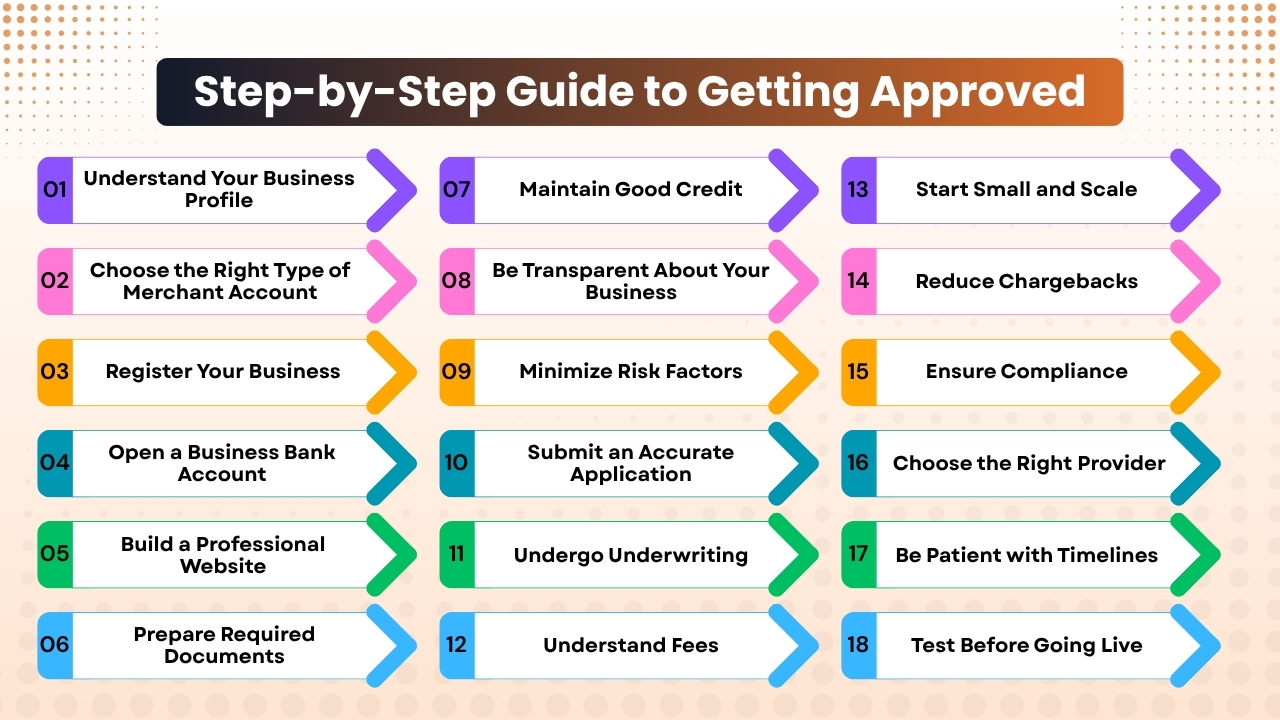
Step 1: Understand Your Business Profile
Before applying for a merchant account, it is crucial to understand and define your business profile clearly . It helps payment providers to evaluate your application correctly and reduces the chances of rejection.
With a complete view of your operations, you can also select a provider that best fits your requirements.
Start by checking your monthly transaction volume, that shows how much revenue your business expects to process. It determines your average transaction size, like higher-value transactions that may have different risk considerations.
It is also essential to identify your business model, whether online, offline, or hybrid, that each requires specific payment solutions. Ultimately evaluate the risk level of your industry because some industries are considered of higher risk than others.
- Monthly transaction volume
- Average transaction size
- Business model (online, offline, hybrid)
- Industry risk level
Understanding all these factors helps to ensure better decision-making and smoother approval.
Also Read: How to Manage a Small Business Using Modern Payment Systems
Step 2: Choose the Right Type of Merchant Account
Choosing the right type of merchant account is a crucial step in the approval. Because the best merchant account option will depend on your business size, transaction volume, and long-term goals.
In 2026, businesses usually select between payment aggregators and dedicated merchant accounts, each having different advantages and limitations.
Payment aggregators are a good option for startups and small businesses that require a quick and simple setup. Because it combines multiple payment services in a single platform, that makes it easy for businesses to start accepting payments without complex requirements.
While dedicated merchant accounts are well suited for growing businesses that require more control, stability, and cost efficiency with time.
1. Payment Aggregators (Easy Approval)
- Best for: Startups, freelancers, low-volume businesses
- Advantages: Fast approval, requires less paperwork, no long-term contracts
- Disadvantages: Higher fees, less control, risk of account holds
2. Dedicated Merchant Accounts
- Best for: good option for growing businesses, high-volume companies
- Advantages: Lower fees over time, greater control, more stability
- Disadvantages: Longer approval process, more documentation
Choosing the merchant account wisely ensures better scalability and smoother payment operations.
Also Read: Merchant Account Services Complete Guide for Business
Step 3: Register Your Business
Registering your business is an important step for getting approved for a merchant account. A legally registered business builds trust with payment providers and proves that your operations are legitimate.
Because without proper registration, your application for a merchant account may get delayed or rejected, while providers require verification of your business identity and compliance with local regulations.
Having complete and accurate information helps to establish credibility and reduces risk from the provider’s perspective.
- Business registration: Businesses may register as an LLC, Pvt Ltd, or other legal structure
- Valid business address: Must match your application and official documents
- Necessary licenses: Required permits depending on your industry
Any unregistered or informal businesses often get rejected, so proper registration is essential for approval.
Also Read: How to Build a Payment Franchise With Ace Merchant Processing
Step 4: Open a Business Bank Account
Opening a dedicated business bank account is essential for merchant account approval. Payment providers require a verified account to securely transfer funds and ensure proper financial tracking.
Using a personal account can increase red flags which may cause delays or rejection. For increasing your chances of approval, ensure your account meets crucial requirements and shows stable financial activity. A business bank account helps them to maintain transparency and separates personal and business finances.
To improve your chances of approval, make sure your account meets important requirements and shows stable financial activity. A well-maintained account builds trust with providers and supports smooth payment processing.
- Account name matches your business: Must align with your registration documents
- Active status: The account should be operational and regularly used
- Clean transaction history: Avoid suspicious or irregular activity
Having a proper business bank account ensures reliable settlements and faster approval.
Also Read: Small Business Inventory Tracking
Step 5: Build a Professional Website
Building a professional website is an important step in getting approved for a merchant account. Payment providers often review your verify the legitimacy of your business, understand the products that you sell, and check potential risk.
A poorly designed or incomplete website may increase problems and cause delays or rejection.
Your website should clearly present your business and provide all crucial information which customers and payment processors expect. Having transparency and professionalism helps to build trust and increases your approval chances.
Even if your business operates offline, then having a basic online presence increases credibility and makes your business easier to verify.
- Product or service details: Clearly describe the products that you offer
- Pricing information: Display accurate and transparent pricing
- Contact information: Include email, phone number, and address
- Refund policy: Explain return and refund terms
- Privacy policy: Outline how customer data is handled
A well-designed website increases credibility and also supports smoother merchant account approval.
Also Read: Why Business Gets Rejected for Online Merchant Account
Step 6: Prepare Required Documents
Preparing your documents in advance is an important step in getting approved for a merchant account. Having incomplete or missing paperwork is one of the most common reasons for approval delays or rejection.
Payment providers use these documents to check your business identity, financial stability, and operational legitimacy. Being organized not just speeds up the approval process but also increases credibility.
Ensure that you have all crucial documents ready and accurate before applying. Offering additional supporting documents can further make your application stronger and reduce the requirements for follow-ups.
Essential Documents:
- Business registration certificate
- Tax identification number
- Business bank account details
- Owner identification (passport or government ID)
- Website URL (for online businesses)
Optional Documents:
- Financial statements
- Processing history (if available)
Having these documents prepared ensures a smoother, faster approval process which shows that your business is reliable and compliant.
Also Read: Top 5 Features Every Retailer Should Look in a Modern Payment Terminal
Step 7: Maintain Good Credit
Maintaining a good credit is essential in getting approved for a merchant account. Payment processors usually review your credit profile to find your financial reliability and overall risk exposure.
Because a strong credit profile indicates that you manage finances well, which increases trust and also improves your chances of approval. It helps to secure better terms which includes lower fees and higher processing limits.
Improving and maintaining your credit requires consistent discipline and smart financial decisions with time. Handling your financial commitments responsibly helps to place your business reliable and financially sound during the application process.
- Pay bills on time: Timely payments establishes a positive credit history
- Reduce outstanding debt: Lower debt improves your credit score and financial profile
- Avoid multiple credit checks: Frequent inquiries can negatively impact your score
Good credit not just increases your chances of approval but also helps to access more favorable pricing and long-term advantages.
Also Read: What Payment Methods Should Retailer Accept
Step 8: Be Transparent About Your Business
It is essential to be transparent about your business while applying for a merchant account. Payment providers must carefully review your operations to understand how you generate revenue and evaluate potential risks.
Any unclear or misleading information can increase concerns, delay approval, or even cause rejection. Having a clear and honest communication helps to build trust and show that your business is legitimate and structured.
You should offer a detailed and accurate explanation of your business activities. This includes describing your products or services clearly, your sales process, and your target audience.
Being transparent allows providers to better evaluate your risk and aligns with the right payment solution.
- What you sell: Clearly define your products or services
- How you sell: Explain whether sales are online, offline, or subscription-based
- Who your customers are: Identify your target market and customer base.
Being open and accurate reduces risk perception, speeds up account approval, and improves your relationship with the payment provider.
Also Read: Top Merchant Account Providers Compared to Businesses
Step 9: Minimize Risk Factors
Reducing risk factors is crucial for improving your chances of merchant account approval. Payment providers carefully check potential risks such as high-value transactions, recurring billing models, and cross-border payments.
When your business appears too risky, it can lead to higher fees, stricter terms, or event rejection. Taking proactive steps helps to reduce such risks which shows that your business is responsible and well-managed.
Common risk areas include selling high-ticket items, that can increase chargebacks, offering subscription billing, that can cause recurring disputes, handle international transactions that may involve additional fraud risks.
Addressing these concerns early can have a more significant impact on your application outcome.
Ways to reduce risk:
- Set clear and fair refund policies
- Avoid misleading marketing or product claims
- Start with lower transaction volumes and scale gradually
Reducing risk helps to build trust and improves approval success.
Also Read: High-Risk Merchant Account Instant Approval
Step 10: Submit an Accurate Application
Submitting the right application is crucial for getting approved for a merchant account. Payment providers usually depend on the data you provide to verify your business, risk, and determine eligibility.
If there are any incorrect or misleading details may raise concerns, slow the approval process, or cause rejection. Being honest and clear helps to build trust and ensures a smoother approval process.
Ensure that all your information is consistent with your documents and shows your actual business operations. Offering clear and realistic data helps providers to properly understand your business and offer suitable terms.
Include:
- Correct business details (name, address, ownership)
- Realistic revenue estimates and transaction volumes
Avoid:
- Exaggerating numbers to appear more established
- Providing incomplete or missing information
It is crucial to have accuracy because it improves approval chances, avoid delays, and establishes a strong foundation for your relationship with the payment provider.
Also Read: Instant Approval Online Merchant Account
Step 11: Undergo Underwriting
Underwriting is a crucial phase in the merchant account approval process where payment providers carefully verify your business risk. This step helps them to determine whether your business is reliable and capable of handling transactions securely.
A thorough evaluation ensures that both the provider and your business are protected from potential financial risks like fraud or excessive chargebacks.
During underwriting, providers review several important factors to understand your overall business profile. These factors help them measure risk and decide on approval terms.
Factors evaluated:
- Industry risk level
- Chargeback history (if available)
- Credit score and financial reliability
- Business model (online, offline, subscription, etc.)
Based on this assessment, there are three possible outcomes:
- Approval: Full access to a merchant account
- Conditional approval: Approval with either limitations or additional requirements
- Rejection: Application getting rejected because of high risk or insufficient information.
Having a strong profile increases your chances of approval and better terms.
Step 12: Understand Fees
Understanding merchant account fees is essential before selecting your merchant account provider. Most businesses focus only on approval but may not check the cost structure that can impact profits over time.
Payment providers may charge for different type of fees, while knowing these fees in advance helps to choose the most cost-effective merchant account provider option and avoid unexpected expenses.
It is crucial to carefully review all pricing details that ensures you fully understand the features that you are being charged for. Transparent pricing helps to plan better and manage your finances efficiently.
Common fees:
Transaction fees: Transaction fees are charged for every payment processed which usually comprises a percentage and a fixed amount.
Monthly fees: It includes monthly fees for ongoing maintenance or service charges.
Chargeback fees: It includes fees applied when customer dispute transactions.
Gateway fees: It includes fees for using the payment gateway to process online payments.
It is essential that you read the contract carefully, which includes hidden charges and terms to avoid any surprise fees and ensure long-term profits.
Step 13: Start Small and Scale
For small businesses it is a smart strategy to begin small while using a merchant account. Payment providers must closely track transactions especially in the early phases.
Sudden increase in transaction volume or large transactions can cause risk alerts, which leads to delays, reviews, or even temporary account holds. Starting with lower volumes, shows stability and builds a positive track record over time.
By gradually increasing your transaction volume allows providers to gain confidence in your business operations. It helps businesses to manage better cash flow, identify potential concerns, and improve their payment processes before growing further.
Being consistent and steady growth are crucial factors which providers search for while assessing long-term reliability.
Step 14: Reduce Chargebacks
It is also essential for small businesses to reduce chargebacks for maintaining a healthy merchant account and ensure long-term approval. Chargebacks happen when customers dispute a transaction, while if there are too many chargebacks then it may indicate high risk to payment providers.
This can cause higher fees, stricter monitoring, and even account suspension. When small businesses keep chargeback rate low indicates that your business is reliable and customer-focused.
To prevent disputes, it is crucial for small businesses to focus on clear communication and strong customer service. Ensuring quick responses and fair policies may also help small businesses to build trust and avoid unwanted conflicts.
Ensuring quick responses and fair policies may go a long way in building trust and preventing unwanted conflicts.
Step 15: Ensure Compliance
Ensuring compliance is crucial for maintaining and getting approved for a merchant account. Payment providers require businesses to follow strict security and regulatory regulations that require businesses to protect sensitive customer data and avoid fraud.
Failing to comply can cause rejection in application, penalties, or even account suspension after approval. Maintaining compliance not just protects your business but also builds trust with customers and payment providers.
It is essential that you comply with industry standards and legal requirements that govern payment processing and data security.
Staying updated with these regulations helps to prevent risks and ensures smooth payment operations.
Step 16: Choose the Right Provider
Choosing the right merchant account provider is essential for long-term business success. Not all providers offer the same features, pricing, or support, so selecting the accurate provider aligns your business requirements to make a difference.
The right provider will not just help to get you approved but also supports your growth and ensures smooth payment operations.
It is essential to evaluate providers carefully based on their policies, costs, and ability to handle specific business models. The right provider choice can improve efficiency, reduce risks, and improve customer experience.
Also Read: Smart POS Systems the Secret of Faster Checkout and Happy Customers
Step 17: Be Patient with Timelines
Being patient with timelines is essential while applying for a merchant account, because approval timelines may be different on the basis of your provider and your business profile. Payment providers require time to review your application, verify documents, and evaluate risk.
When small businesses expect instant approval may cause frustration especially if additional checks are required. By being prepared and responsive may help to make the process smoother.
Approval speed highly depends on the type of merchant account that you select. While some options are designed for quick onboarding, while others may involve more detailed evaluation. By being patient and proactive helps to ensure a successful approval process.
Step 18: Test Before Going Live
Before you start accepting real customer payments, it is crucial to thoroughly test your merchant account setup. Testing ensures that your payment works accurately, prevents transaction errors, and offers a smooth experience for your customers.
Avoiding this step may cause failed payments, delays in settlements, or customer dissatisfaction.
Running tests helps to identify and fix any technical or operational issues in advance. This helps to ensure that your checkout process, payment approvals, and fund transfers are all working as expected.
While proper testing ensures that security features and fraud detection systems are working effectively.
Conclusion
As a small business, getting approved for a merchant account in 2026 may seem complex, but it becomes more manageable with the right approach and preparation.
By understanding your business profile and selecting the right provider, preparing documents, maintaining good credit, and ensuring compliance ensures that each step plays a crucial role in the approval process.
Small businesses by being organized , transparent, and proactive can highly increase their chances of success. It is crucial to remember that payment processors are focused on reducing risk, and not blocking businesses.
When you present your business clearly, reduce potential risks, and follow best practices, you build trust and credibility. Begin with the right setup whether it is a payment aggregator or a dedicated merchant account that can also make a big difference based on your current business phase.
Beyond approval, maintaining your merchant account is crucial. Tracking transactions, reducing chargebacks, and staying compliant with regulations that ensures long-term stability and growth. While your business expands, you can grow your payment solutions to match increasing demand.
Ultimately, a well-managed merchant account empowers small businesses to accept payments smoothly, improve customer experience, and drive consistent growth and drive consistent growth in an increasingly competitive digital marketplace.
If you still have any query about how small businesses can get approved for a merchant account then you may book a free demo at Ace Merchant Processing and we are more than happy to assist you.